


Bank of Taiwan Successfully Hosts 2026 Precious Metals Real-World Assets Forum
(中央社財經訊息服務20260623 16:32:03)
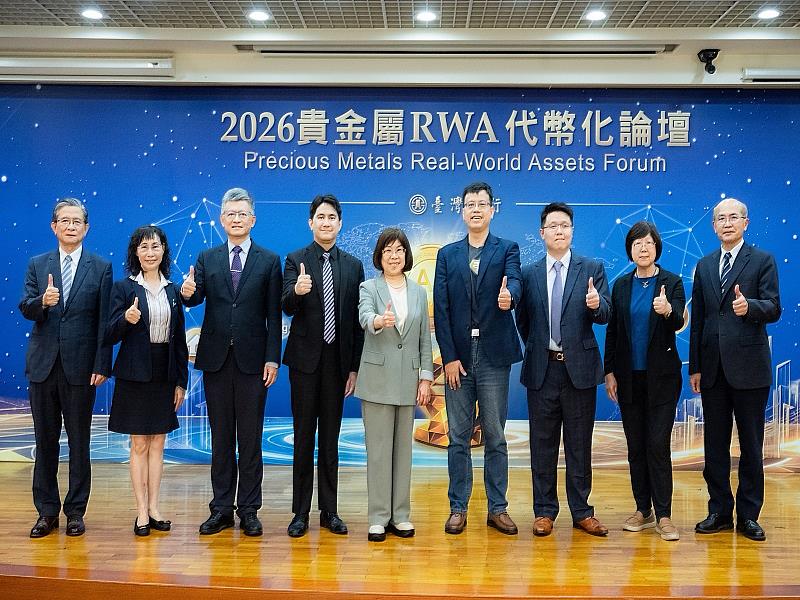
In celebration of the 127th anniversary of Bank of Taiwan (BOT), the Bank successfully hosted the 2026 Precious Metals Real-World Assets Forum on May 15, 2026, at the Auditorium of its Guiyang Building in Taipei. The forum brought together nearly 100 participants, including representatives from financial institutions, corporate clients, and industry professionals, to discuss emerging trends and application opportunities in the tokenization of precious metals as Real-World Assets (RWA). The event also provided a platform for industry dialogue and knowledge exchange, reflecting the growing interest in this rapidly evolving area of digital finance.
The forum commenced with opening remarks by Chairperson Ling Chung-Yuan of Bank of Taiwan. Chairperson Ling noted that precious metals have long been one of BOT's core business strengths, supported by decades of market experience and customer trust. As blockchain technology and digital finance continue to reshape the financial landscape, BOT intends to actively explore the tokenization of real-world assets such as gold to enhance portfolio flexibility, improve transaction efficiency, and support financial innovation while maintaining prudent risk management and regulatory compliance. She also expressed appreciation to the distinguished speakers and guests for their participation and emphasized her hope that the forum would foster practical insights and inspire future cross-sector collaboration.
The forum featured three distinguished experts who examined the development and implications of gold RWA tokenization from the perspectives of global market trends, financial practice, and legal and regulatory frameworks.
Speakers highlighted how blockchain technology is driving a structural transformation of the traditional gold market by addressing long-standing limitations related to storage, liquidity, and transaction costs. As a result, gold is evolving beyond its traditional role as a safe-haven asset into a programmable and composable digital asset capable of supporting innovative applications in decentralized finance (DeFi), cross-border payments, and financial inclusion.
From the perspective of financial institutions, gold RWA tokenization represents more than a technological enhancement—it has the potential to fundamentally reshape banking business models. The adoption of on-chain pricing, atomic settlement, and real-time clearing mechanisms can significantly reduce reconciliation costs between institutions, mitigate transaction risks, and improve operational efficiency and market transparency. Within this emerging ecosystem, banks are expected to evolve from traditional intermediaries into trusted infrastructure providers and key participants in blockchain-based financial networks. Institutions that establish an early presence and earn customer trust are likely to gain a significant competitive advantage in the future digital asset economy.
From a legal perspective, the essence of RWA tokenization lies in transforming the mechanism by which ownership rights are represented and transferred. Traditional ownership records maintained through centralized ledgers are replaced by distributed ledger technology (DLT), fundamentally changing how asset ownership is evidenced and transferred. Accordingly, policymakers and regulators must carefully address issues including legal requirements for asset transfer, the legal classification of virtual assets, and the scope of applicable regulatory oversight. Establishing clear and robust legal frameworks will be critical to ensuring transaction legitimacy, ownership authenticity, market integrity, and effective risk management.
Taken together, the discussions underscored that gold tokenization is not only a technological innovation but also an important catalyst for the co-evolution of financial systems, market infrastructure, and regulatory frameworks.
Following a networking session, the afternoon panel discussion was moderated by Terry Yang, EVP& General Manager of BOT's Precious Metals Department, and focused on the development of gold-backed tokens, virtual assets, and strategic responses by financial institutions.
Panelists explored a wide range of topics, including the evolving role of banks, regulatory challenges, asset custody arrangements, and future business opportunities. Discussions also examined the competitive and complementary dynamics between gold-backed tokens, traditional gold markets, and U.S. dollar stablecoins, as well as the implications of blockchain technology and smart contracts for financial security and customer protection.
Participants further exchanged views on regulatory implementation issues, including token freezing mechanisms, transaction traceability, and future licensing frameworks. The session concluded with a highly interactive Q&A session, during which attendees submitted real-time questions through Slido and engaged in lively discussion.
Overall, participants agreed that gold tokenization represents a promising entry point for broader asset tokenization initiatives. It offers significant potential to enhance asset liquidity, improve transaction accessibility, and support the development of innovative financial applications. Nevertheless, successful implementation will require continued progress in regulatory frameworks, custody solutions, compliance systems, technology governance, and organizational readiness within financial institutions.
As a pioneer in the development of precious metals RWA tokenization, Bank of Taiwan remains committed to playing a leading role in advancing this transformative financial innovation. Through cross-disciplinary dialogue and industry collaboration, the Forum has contributed to a deeper understanding of key issues surrounding gold tokenization and provided valuable insights to support the future development of tokenized gold products and related regulatory frameworks in Taiwan.