


Citi Pioneers Digital Asset Offerings with Token Services and Crypto Custody
(中央社財經訊息服務20260707 11:12:21)
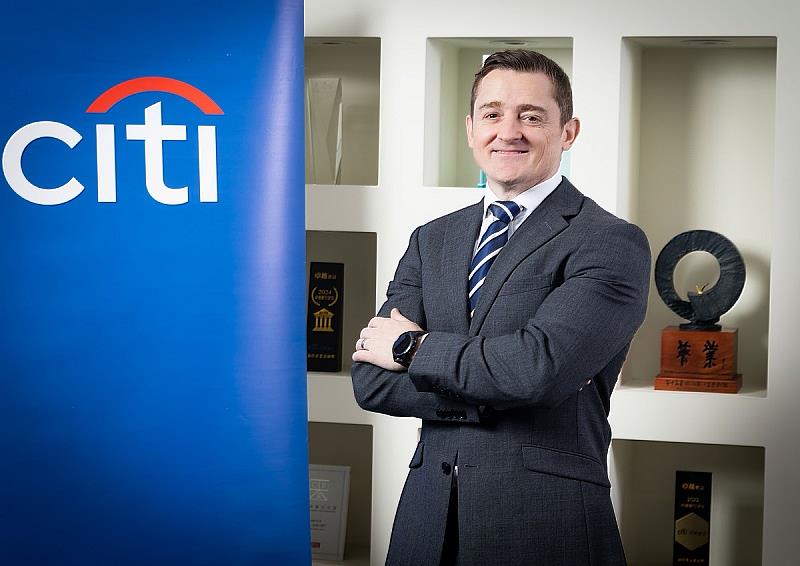
Mark Attard is the Head of Digital Assets and Client Relationships for Citi Services business, responsible for the Asia South and JANA clusters. With over two decades of outstanding experience in corporate banking, wealth management, and investment banking, Mark, during his visit to Taiwan, provides insights into Citi's digital asset strategy in response to the rapid development of Taiwan's digital asset market and increasing client demands, as well as how to bring more efficient and transparent financial service solutions to Taiwan. The following is an interview with Mark Attard on Citi's digital asset strategy and development:
1. What is Citi Services’ digital assets strategy?
The architecture of how money and assets move and settle is changing, reflecting a broader shift in how value moves through Citi’s network and the broader financial system. In our Services business, we have been building blockchain and digital assets capabilities for around five years, and our roadmap is shaped directly by what our clients and partners tell us they actually need.
To that end, we have launched Citi Token Services, and we are building out digital asset custody capabilities and connectivity to new blockchain networks. Through Citi Token Services, we are enabling clients to move liquidity near instantaneously on a 24/7 basis across select markets and currencies. We are modernizing payment rails, enhancing collateral mobility and building capabilities aligned with where the commercial ecosystem is going. These investments create optionality for our clients and for the firm.
2. Can you share some examples of how Citi is expanding its blockchain including digital asset custody capabilities?
We are live with Citi Token Services, our private permissioned blockchain, in five markets globally supporting both U.S. dollars and Euro flows. These markets include the US, UK, Hong Kong, Singapore and Dublin, and we will continue to expand into new corridors and currencies. Client adoption has been strong, with hundreds of clients moving close to US$1 billion each day through tokenized deposits. Our clients in Taiwan who have accounts in the five Citi Token Services markets are also using the solution to support their liquidity and operational needs.
As assets become more digital and settlement accelerates, the way securities are issued, serviced, financed and held will evolve. We are investing in digital asset custody and modernizing post trade infrastructure so that clients can safekeep and mobilize assets with the same confidence they expect today. As we establish Citi as a one-stop custodian, serving both traditional and digital assets within the same operational framework, we expect to go live with our crypto custody offering later this year. We will begin by servicing Bitcoin assets.
3. How does Citi envision tokenization transforming the issuance, holding, and transfer of various assets?
We see tokenization as a transformative force, particularly in enhancing efficiency across global asset management. Given our extensive international presence, tokenization, especially through Citi Token Services, addresses challenges like disparate time zones and operational cut-off times by enabling 24/7 liquidity and payment functionalities. This capability is expected to extend to tokenized securities, allowing for extended trading hours and the efficient use of collateral for settlement and margin. Ultimately, tokenization within established regulatory frameworks will drive significant operational improvements, aligning with the evolving demand for continuous, "always-on" financial services.
4. Citi recently announced Digital Depositary Receipts, enabling greater accessibility into private markets for global issuers and investors. Can you share more about how this model works in practice?
We introduced Digital Depositary Receipts (DDR) representing shares in a private company and successfully completed the first issuance for Kaleido, a Citi portfolio company. This marked the first time that a global bank is both issuing and acting as a custodian for tokenized depositary receipts representing private companies.
As IPO timelines stretch, private companies are seeking alternate routes to access liquidity instead of navigating fragmented secondary markets. This innovation is designed to ensure issuers receive efficient distribution and transfer without the need for public listing or altering underlying ownership rights. Companies maintain control over voting and a more simplified cap table management structure while broadening investor outreach.
Building on Citi’s industry-leading Depositary Receipts and Custody businesses, DDRs provide a flexible, institutional-grade alternative capable of meeting the scale needed for private markets.
5. How does Citi approach collaborations with fintechs and other digital-native entities within this evolving ecosystem?
Collaborations with fintechs and digital innovators are a high-priority strategic area for Citi, with dedicated teams focused on identifying and leveraging these opportunities.
As an example, we have announced a partnership with Coinbase to strengthen the bridge between traditional and decentralized finance, and we continue to evaluate our role in the stablecoin and digital assets ecosystem as client needs develop.
Our strategy often involves a build-versus-buy analysis, and in cases of significant co-development or strategic alignment, we engage in strategic investment programs by taking equity stakes. This multi-faceted approach, encompassing collaboration, integration, and investment, allows us to foster deeper relationships and accelerate ecosystem development.