




- Groundbreaking for Qixingtan Visitor Center: NT$190M Project to Build “Whale Leaping” Tourism Gateway
- Hualien Ranks No. 1 Nationwide in Good Air Quality Days: Where Breathing Fresh Air is the Daily Standard
- 花蓮縣政府回應光復堰塞湖洪災爭議 重申依法防災、向罹難者致哀
- 花蓮縣婦幼福利一次看 115年規劃新增RSV疫苗、調升托育獎勵金
- 光復青年50萬創業補助申請倒數不到1個月 花蓮縣府籲把握時程申請
Rare 15.4-Meter Whale Found Off Hualien—Experts to Study and Preserve Skeleton for National Museum
(中央社訊息服務20260319 10:32:26)On the morning of March 4, the Chongde Inspection Station of the 12th Shore Patrol Corps under the 9th Patrol District, Eastern Branch of the Coast Guard Administration (CGA), Ocean Affairs Council, received a report regarding a deceased baleen whale discovered at the Tung Yi Fa set-net fishery off the coast of Hualien. The carcass appeared visibly bloated and showed clear signs of decomposition. In a coordinated effort, relevant agencies towed the whale to shore, where it has been covered with tarpaulins and secured behind a safety cordon. Officials urge the public to keep a safe distance because decomposing whale remains can accumulate significant amounts of gas, which may pose a sudden physical risk.
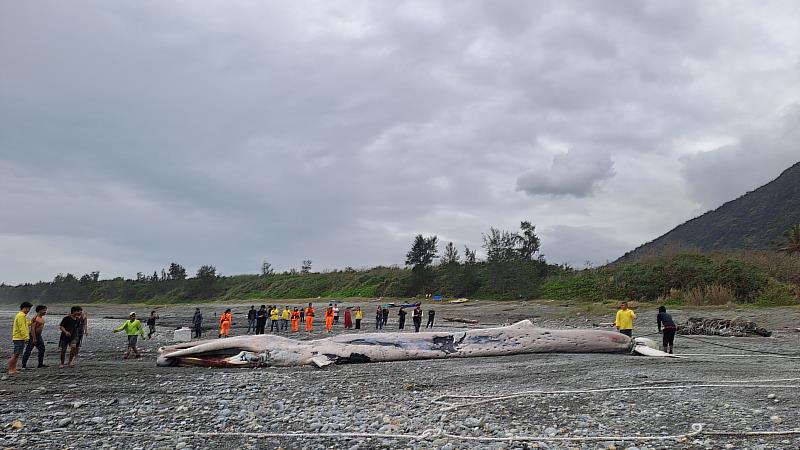
After receiving the report, the Ocean Conservation Administration (OCA) and the Agriculture Department of Hualien County Government immediately activated interagency response procedures under the Marine Animal Rescue Network (MARN). Because baleen whales are designated by the OCA as species subject to sampling and research by the central competent authority, the Hualien County Government agreed, after coordination, to transfer authority over subsequent handling of the case to the OCA for overall management. The OCA commissioned the set-net fishery operator to assist in hauling the whale ashore with heavy equipment, and initial necropsy and sampling work is scheduled for the following day. Participating teams will include experts from the National Museum of Natural Science, National Taiwan University, National Cheng Kung University, the Taiwan Cetacean Society, the Kuroshio Ocean Education Foundation and its volunteers, Farglory Ocean Park personnel, and other relevant staff. After sampling is completed, the skeletal remains are expected to be prepared as specimens and transferred to the National Museum of Natural Science in Taichung for collection and exhibition, serving the purposes of marine education and scientific research.
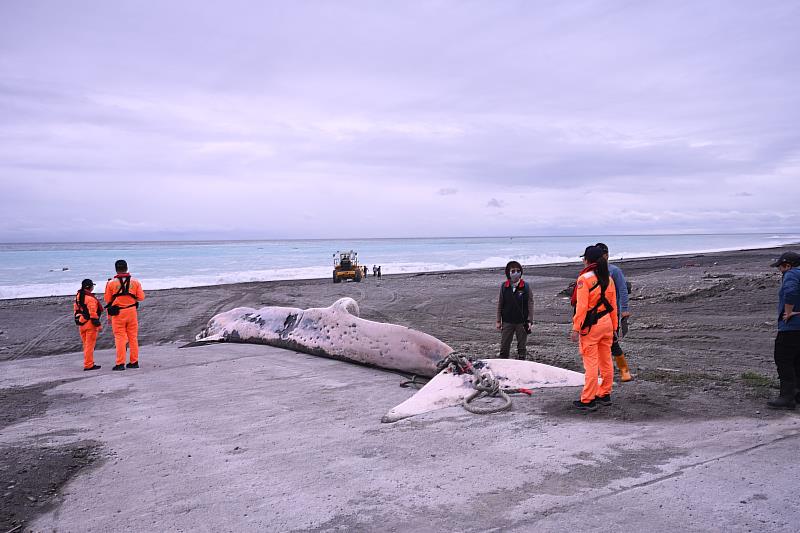
During the towing process, gases produced by decomposition inside the body caused severe abdominal swelling, along with leakage of bloody fluid and gas. The whale measured 15.4 meters in length. Based on its external appearance, experts preliminarily believe the individual may have died several days earlier, drifted with ocean currents to waters off Hualien, surfaced, and ultimately entered the set-net fishing area. Judging from external features such as the ventral pleats, the whale may be either a fin whale or a Bryde’s whale. Its exact species, however, will need to be confirmed through necropsy and specimen analysis.
The waters off Hualien are rich in marine ecological resources due to their deep-sea canyon topography and the passage of the warm Kuroshio Current, making them a common habitat for whales and dolphins. As for the cause of death in this case, possible factors include natural aging, disease, parasites, ingestion of marine debris, vessel collision, fishing gear entanglement, or changing sea conditions. Confirmation will depend on follow-up necropsy and laboratory analysis.
The OCA and the Agriculture Department of Hualien County Government also reminded the public that if stranded cetaceans or other abnormal whale or dolphin sightings are found along the coast or at sea, they should immediately call 118 to report the case to the CGA. Members of the public should never attempt to push the animal back into the sea on their own, and should avoid touching or disturbing it. They are also encouraged to follow the “three do’s and four don’ts” principle when helping to protect cetaceans: do keep the animal upright, do keep it moist, and do record its breathing and heartbeat; do not expose it to strong wind or direct sunlight, do not stand too close to its head or tail, do not push, drag, or pull it, and do not make loud noises. Through these actions, everyone can help protect Taiwan’s precious marine ecological resources.