




- NYCU Brings Gamified Precision Elderly Care to Hsinchu in New AI-Powered Healthy Aging Initiative
- NYCU and Yang Ming Marine Transport Launch AI Partnership for Smart Shipping and Sustainable Supply Chains
- NYCU Study Links IVF Births to Higher Risk of Congenital Heart Disease in Children
- NYCU and Chiayi University Win Six Gold Medals in Japan for Herbal Medicine Innovation
- NYCU Awards Honorary Doctorate to Phison Electronics CEO Khien-Seng Pua
NYCU, Academia Sinica, and NTHU Develop “EcoDecibel” Sensors to Map Urban Noise in Real Time
(中央社訊息服務20260525 16:21:08)Noise pollution has become an unavoidable part of life in modern cities. From the constant hum of traffic to late-night construction and densely packed residential streets, urban sound is everywhere — yet much of it remains difficult to monitor in real time.
Now, researchers from National Yang Ming Chiao Tung University (NYCU), Academia Sinica, and National Tsing Hua University (NTHU) have developed a portable, low-cost sensing system called EcoDecibel that could change how cities understand and manage environmental noise.
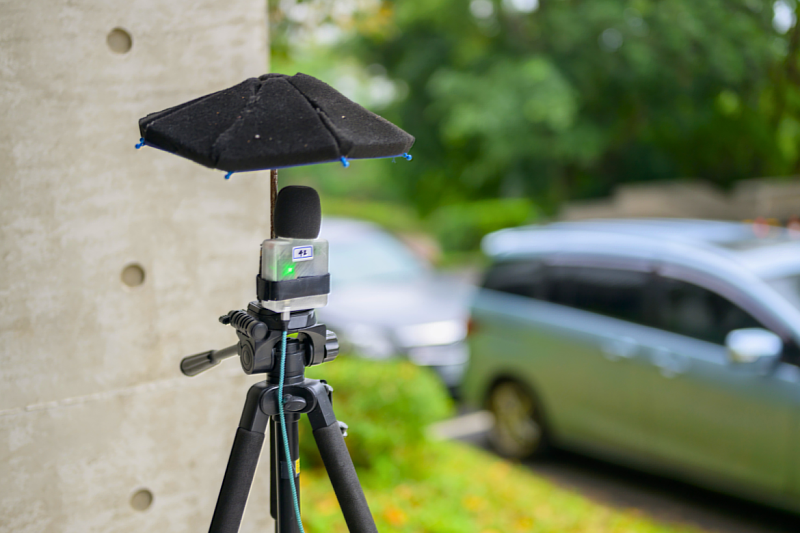
The lightweight device functions like a network of “small ears” distributed across the city. Installed on roadsides, campuses, and residential buildings, the sensors continuously capture ambient sound levels and transmit the data to cloud-based AI systems that generate real-time noise maps.
Traditional noise monitoring typically relies on professional-grade instruments installed at only a limited number of fixed locations. While highly accurate, such systems are expensive to deploy and often unable to fully reflect the complexity of urban soundscapes across different neighborhoods and daily environments.
To address this challenge, the research team developed a compact, high-sensitivity sensing module that can be flexibly deployed in public spaces. Because the sensors are inexpensive and portable, multiple units can operate simultaneously across an area, allowing cities to build what researchers describe as a distributed “listening network.”
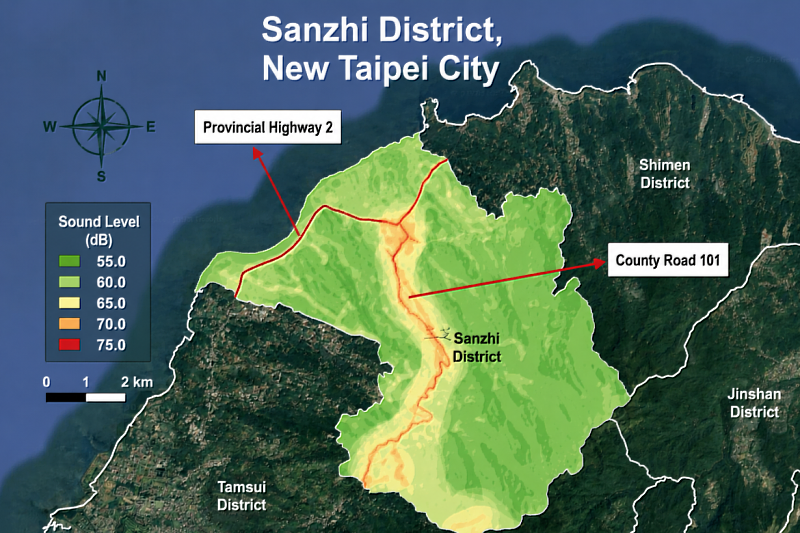
Powered by standard mobile battery packs, the devices can be installed almost anywhere — from roadside utility poles to community spaces and school campuses. The collected audio data is transmitted to cloud computing resources provided by Chunghwa Telecom, where AI models analyze sound patterns and generate visualized “noise hotspot” maps for environmental monitoring and urban planning.
Compared with conventional monitoring equipment that can cost tens or even hundreds of thousands of Taiwan dollars, each EcoDecibel sensor costs only around NT$1,000 (US$30), making large-scale deployment significantly more feasible. The system has already been tested in several districts across northern Taiwan, including Sanzhi in New Taipei City and Linkou, Guishan, and Luzhu in Taoyuan. According to the research team, the lightweight sensors achieved measurement accuracy comparable to Taiwan’s official environmental noise monitoring standards.
Beyond inconvenience, researchers say environmental noise is increasingly recognized as a public health issue linked to sleep disruption, mental stress, cardiovascular disease risk, and children’s learning performance.
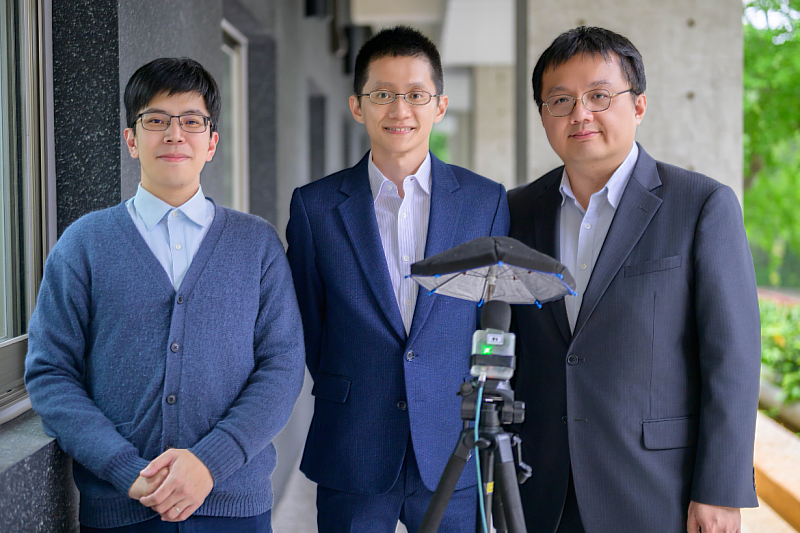
Wen-Chi Pan, director of the Institute of Environmental and Occupational Health Sciences at NYCU’s College of Medicine and the project’s lead integrator, said the ability to continuously record environmental sound over long periods could provide an important foundation for future health studies and environmental governance. The project was also designed to address a key limitation of traditional monitoring systems: their inability to capture neighborhood-level differences in real time.
“We wanted to make environmental data closer to people’s real daily lives,” said Ling-Jyh Chen, a research fellow at Academia Sinica’s Institute of Information Science who led the hardware development. Chen noted that the concept resembles Taiwan’s widely recognized “AirBox” PM2.5 monitoring initiative, which drew international attention for its citizen-based environmental sensing model. Like AirBox, EcoDecibel aims to make environmental data more immediate, localized, and accessible to the public.
Instead of relying on only a few centralized monitoring stations, the distributed sensing approach reveals how noise shifts across neighborhoods and throughout the day. Min-Hsuan Lee, an assistant professor in the PhD Program in Biomedical Intelligent Systems at NTHU and a co-investigator on the project, said the system could help make environmental management “more immediate and more precise.”
The EcoDecibel system was developed with additional support from Chunghwa Telecom’s smart analytics platform and cloud computing infrastructure, as well as technical assistance from the Optoelectronics Research Laboratories at Industrial Technology Research Institute.
As cities worldwide continue to seek more sustainable and data-driven approaches to environmental management, the researchers hope that networks of these “small ears” can eventually expand into more communities — helping to make urban noise easier to understand, visualize, and manage.