




- NYCU–Japan Collaboration Unveils World’s First Automated Stem Cell Cultivation System
- NYCU Hosts MEGA DAY as Startups Converge Across the Indo-Pacific
- NYCU College of Nursing Expands Global Footprint with High-Level Exchanges from the U.S., Australia, and the Philippines
- NYCU Partners with Siemens Taiwan and Mega Flow to Build AI-Driven Engineering Simulation Platform
- NYCU and TVGH Announce New Asian Guidelines Lowering Sarcopenia Screening Age to 50
NYCU Teams Up with U.S. Chipmaker Altera to Launch World’s Largest FPGAi Joint Lab
(中央社訊息服務20251218 10:47:59)As global demand for semiconductor and AI talent accelerates, National Yang Ming Chiao Tung University (NYCU) has partnered with U.S. semiconductor company Altera to launch what the university says is the world’s largest Altera Joint FPGAi & Soc Laboratory, underscoring Taiwan’s push to strengthen chip design education and industry-ready training.
The new laboratory, established at NYCU’s Kaohsiung campus, is backed by a donation worth nearly NT$70 million (about US$2.2 million) in advanced teaching boards and software from Terasic Inc., Altera’s long-time partner. The facility will support hands-on instruction in digital circuit design, AI acceleration, and system-on-chip (SoC) development—skills increasingly seen as critical to the global semiconductor supply chain.
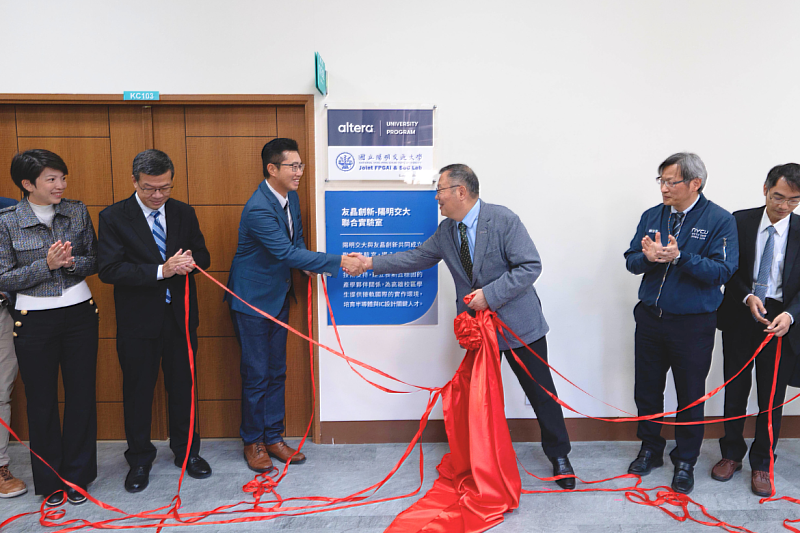
NYCU President Chi-Hung Lin said the collaboration aims to narrow the gap between academic training and real-world engineering demands by embedding industry-standard tools directly into teaching and research.
“Students will be able to learn and experiment using the same platforms adopted by leading semiconductor companies,” Lin said, adding that the laboratory will enable deeper exploration in AI, communications, and intelligent systems.
He noted that NYCU’s Kaohsiung campus is positioning itself as a focal point for semiconductor technology, AI-driven systems, applied sciences, and smart manufacturing, supported by industry partnerships and interdisciplinary education models.
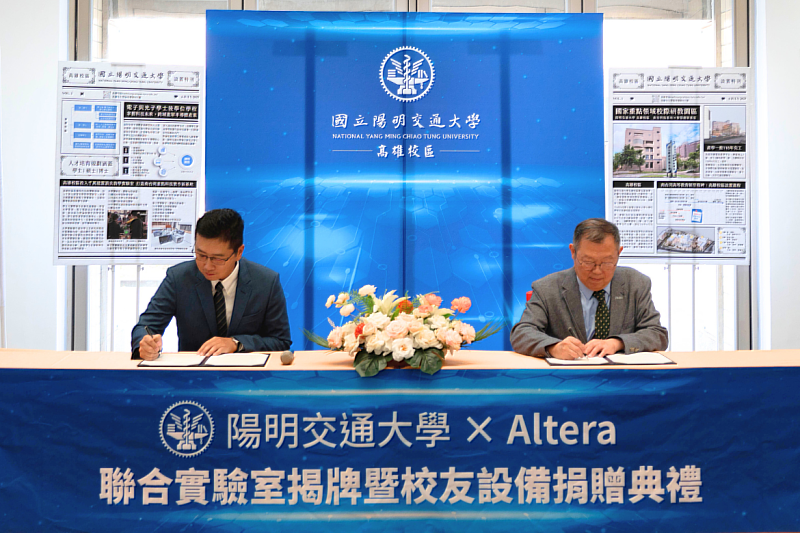
For Hsien-En Peng, Chairman of Terasic Inc. and an NYCU alumnus, the initiative reflects a long-term investment in Taiwan’s economic future.
“IC and SoC design talent is the lifeblood of Taiwan’s economy,” Peng said. “University programs—from digital logic to advanced chip design—are where this talent is forged.”
The Joint FPGAi & Soc Laboratory is equipped with Altera’s latest Agilex 5 FPGA, paired with the newly developed DE25-Standard board. Peng described the setup as a “supercar” for chip design education, capable of supporting both foundational coursework and advanced AI chip development.
Peng also pointed to Terasic’s two-decade role as a hardware design partner in Altera’s global university program. During that time, the company has helped establish FPGA laboratories at more than 3,000 universities worldwide and delivered over 300,000 FPGA boards.
“AI breakthroughs ultimately depend on hardware acceleration and chip design to reach society,” Peng said. “Developing talent that can combine AI with hardware—whether in biomedicine or other fields—is essential.”
He added that the Joint FPGAi & Soc Laboratory represents only the first phase of a broader, long-term collaboration with NYCU and Altera to support Taiwan’s next generation of engineers.
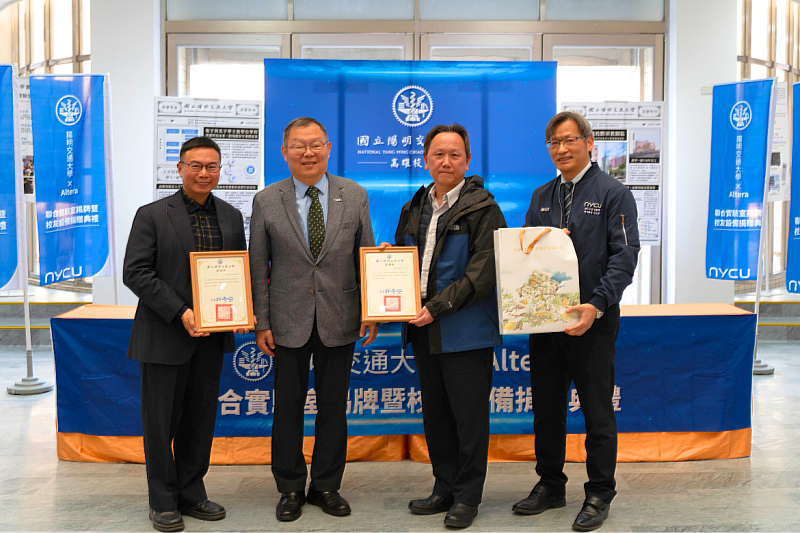
NYCU Vice President Yung-Fu Chen said the joint laboratory will provide students with a complete FPGAi and SoC integration platform, designed to shorten the learning curve and emphasize practical application.
The platform will support projects in AI acceleration and edge computing, signal processing, SoC chip design, and advanced communication system prototyping, giving students hands-on experience in digital logic design and system integration.
With the launch of the Joint FPGAi & Soc Laboratory, NYCU is reinforcing Taiwan’s position not only as a manufacturing powerhouse but also as a critical training ground for next-generation chip designers and system engineers.
At a time when countries and industries worldwide are racing to secure semiconductor talent, the NYCU–Altera collaboration highlights how university–industry partnerships are becoming a strategic pillar in sustaining innovation across AI, advanced computing, and intelligent systems. For Taiwan, the initiative signals a broader effort to ensure that breakthroughs in chip technology are matched by a steady pipeline of engineers capable of turning ideas into real-world impact.