




- NYCU International Symposium Explores How Future Medicine Will Be Built
- NYCU and TSMC Expand Semiconductor Talent Development Through Summer Courses
- Together Toward Infinite Possibilities: NYCU Celebrates the Class of 2026
- NYCU Student Team Reaches Finals at Singapore Autonomous Underwater Vehicle Challenge
- NYCU Patents Smart Surface Technology to Eliminate Signal Dead Zones
NYCU and Phison Partner to Build Campus-Wide AI Compute Governance Platform
(中央社訊息服務20260623 16:02:07)As artificial intelligence continues to advance, the focus of AI development is gradually shifting beyond raw computing power toward a new challenge: how to manage, allocate, and optimize computing resources efficiently.
To address this emerging need, National Yang Ming Chiao Tung University (NYCU) and Phison Electronics have launched a joint initiative to establish a campus-wide GPU resource management platform, creating a more integrated and efficient AI computing environment for research, education, and innovation.
The collaboration was marked by a donation ceremony on June 22 to deploy the Phison Heterogeneous Computing Infrastructure (Phison HCI), an AI heterogeneous computing resource management platform. The project brings together NYCU’s College of Computer Science, College of Electrical and Computer Engineering, Industry Academia Innovation School, and Information Technology Service Center, reflecting a university-wide effort to strengthen AI infrastructure through shared governance and cross-disciplinary collaboration.
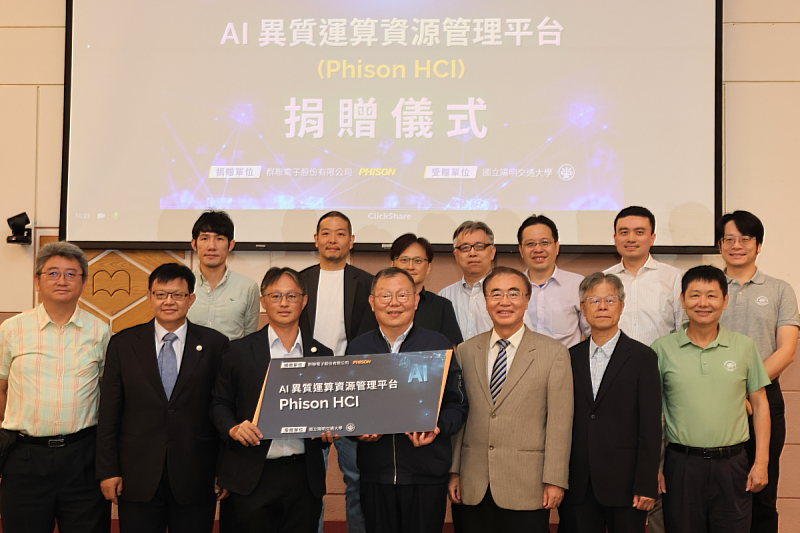
The rapid expansion of AI has led universities and research institutions worldwide to invest heavily in high-performance computing resources. Yet as GPU clusters continue to grow, ensuring that these resources are effectively utilized has become an increasingly important challenge.
NYCU President Chi-Hung Lin noted that as one of Taiwan’s leading hubs for AI and semiconductor talent development, the university has continuously invested in advanced computing infrastructure and AI research capabilities. However, the growing number of GPU systems across different academic units has also created new demands for resource coordination and sharing.
“Connecting computing resources across departments and improving overall utilization have become critical priorities,” Lin said.
By introducing the Phison HCI platform, NYCU aims to improve the efficiency of existing computing resources, enable broader access to AI infrastructure, and support interdisciplinary research projects that require large-scale computing power. The platform is also expected to strengthen collaboration among researchers, faculty members, and students while expanding opportunities for innovative AI applications.
According to Khein-Seng Pua, the initiative extends beyond addressing current GPU management needs. “Our goal is to help NYCU establish a scalable AI computing infrastructure that can evolve with future technologies,” Pua said.
He explained that the platform is designed to gradually integrate emerging computing technologies, including AI application-specific integrated circuits (AI ASICs), inference accelerators, and other heterogeneous computing devices. With a Software-Defined Compute architecture, the system will provide a unified management environment that supports diverse hardware platforms and future generations of AI computing technologies.
Such flexibility, he noted, is increasingly important as AI workloads become more specialized and heterogeneous, requiring institutions to manage a broader range of computing architectures rather than relying solely on traditional GPU resources.
Beyond improving campus computing efficiency, the partnership is expected to serve as a reference model for AI infrastructure development across Taiwan’s higher education sector.
By combining academic expertise with industry experience, NYCU and Phison aim to create a shared AI computing ecosystem that supports advanced research, accelerates innovation, and strengthens talent development in both AI and semiconductor technologies.
As AI continues to reshape scientific discovery, education, and industry, effective compute governance is becoming as important as computing power itself. Through this collaboration, NYCU is taking another step toward building the infrastructure needed to support the next generation of AI-driven research and innovation.