




- NYCU and Phison Partner to Build Campus-Wide AI Compute Governance Platform
- NYCU International Symposium Explores How Future Medicine Will Be Built
- NYCU and TSMC Expand Semiconductor Talent Development Through Summer Courses
- Together Toward Infinite Possibilities: NYCU Celebrates the Class of 2026
- NYCU Student Team Reaches Finals at Singapore Autonomous Underwater Vehicle Challenge
2026 Taiwan Bamboo Expo Spotlights Bamboo Innovation at NYCU
(中央社訊息服務20260625 15:05:17)Visitors arriving at National Yang Ming Chiao Tung University (NYCU) are often drawn first to the tranquil scenery surrounding Bamboo Lake, where rows of bald cypress trees reflect on the water, and students gather beneath the shade of the lakeside landscape. In recent years, however, another feature has quietly reshaped the campus experience. Across lawns, pathways, and waterfront spaces, a growing collection of bamboo structures has transformed NYCU into one of Taiwan’s most distinctive hubs for bamboo innovation—a place where architecture, engineering, digital fabrication, and sustainability converge.
Over the past five years, bamboo has taken on a new role across the campus. What was once associated primarily with traditional craftsmanship now appears in architectural installations, public spaces, and experimental structures that explore new possibilities for sustainable design. Supported by a talent development initiative jointly promoted by Taiwan’s Forestry and Nature Conservation Agency and the Taiwan Bamboo Society, architects, engineers, artisans, and students from Taiwan and abroad have collaborated to explore new possibilities for bamboo construction.
This year, NYCU has become a permanent exhibition venue for the Hsinchu section of the 2026 Taiwan Bamboo Expo. Under the theme “The Everyday Life and Future of Bamboo,” the campus itself serves as an open-air exhibition, inviting visitors to experience how a centuries-old material is being reimagined for the challenges of the future.
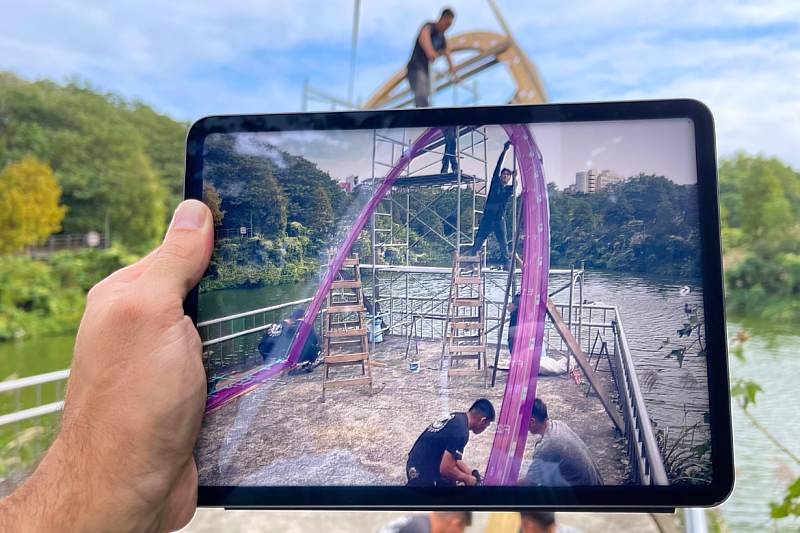
According to Pei-Hsien Hsu, Director of NYCU’s Graduate Institute of Architecture and Chair of the Taiwan Bamboo Society, one of the most encouraging developments has been the increasing participation of younger generations.
“In recent years, we have seen more young architects and students engage in bamboo research, design, and construction,” Hsu said. “Through design education, international workshops, and hands-on building experiences, bamboo is becoming an important medium for exploring sustainable architecture and rediscovering its relevance in contemporary life.”
Today, the campus showcases a diverse range of bamboo structures that demonstrate how traditional materials can intersect with advanced engineering, digital technologies, and environmental design.
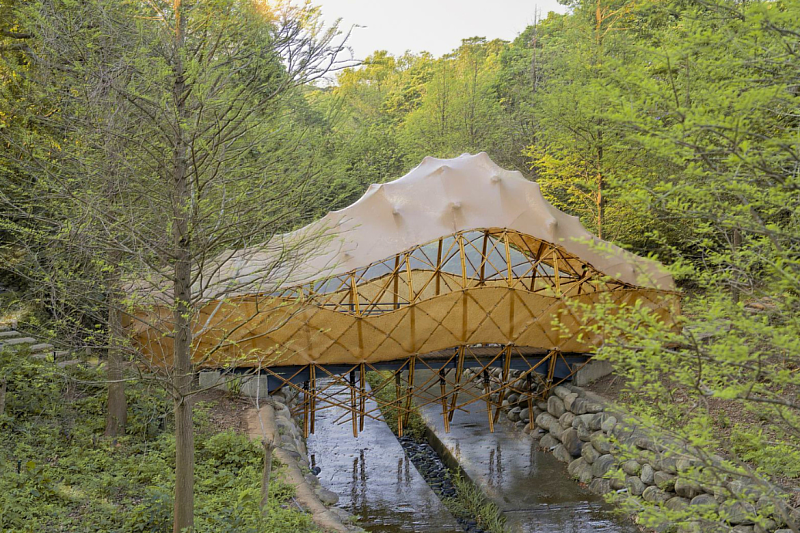
Among the most recognizable works is Bridge Cocoon, designed by Taiwanese architect NK Kuo. Inspired by the protective cocoon built by insects during metamorphosis, the project introduced steam-bending techniques—traditionally used in timber construction—to bamboo for the first time in Taiwan. Through a carefully controlled steaming process, locally sourced Makino bamboo retains its natural fiber strength while achieving elegant curved forms.
The resulting structure combines bamboo arches, handmade bamboo paper, fabric membranes, and recycled marine waste buoys to create an immersive cocoon-like environment integrated with a pedestrian bridge along the lake. During the day, sunlight filters through the bamboo framework, casting shifting patterns of light and shadow. At night, the structure glows softly from within. Walking through the installation evokes a symbolic journey of transformation, renewal, and emergence. The project received national recognition by winning the Grand Prize at Taiwan’s Seventh ADA New Architects Award.
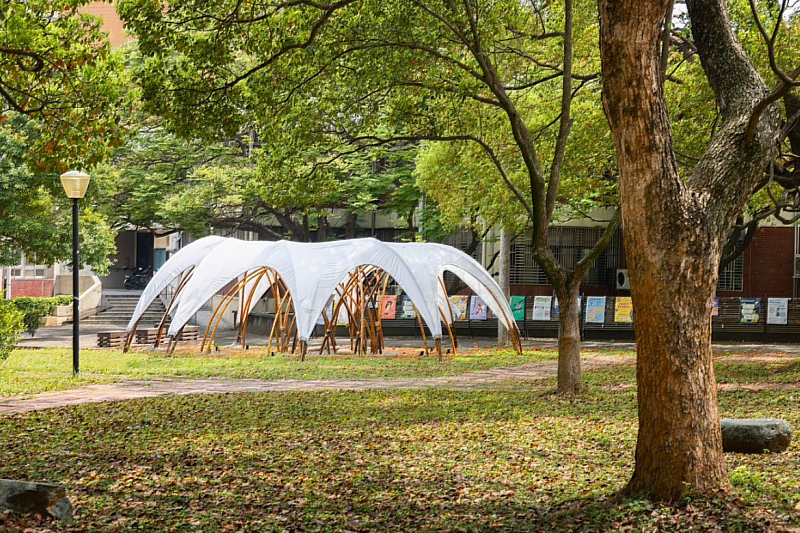
Located in front of NYCU’s Engineering Building 1, Bamboo Dome explores the relationship between structural logic and natural materials. Designed collaboratively by Japanese structural engineer Hideyuki Hagiuda and Taiwanese structural engineer Kuan-Fan Chen, the installation is built around a system of interlocking bamboo arches. Its location was intentionally chosen to encourage engineering and architecture students to reconsider the role of natural materials in structural design.
Viewed from above, the dome resembles a starburst radiating outward across the landscape. At ground level, overlapping bamboo arches form a semi-open gathering space where sunlight filters through narrow gaps, creating an environment that balances technical precision with organic beauty. The structure serves not only as a gathering place but also as a teaching tool, demonstrating how sustainable materials can be integrated into contemporary engineering practice.
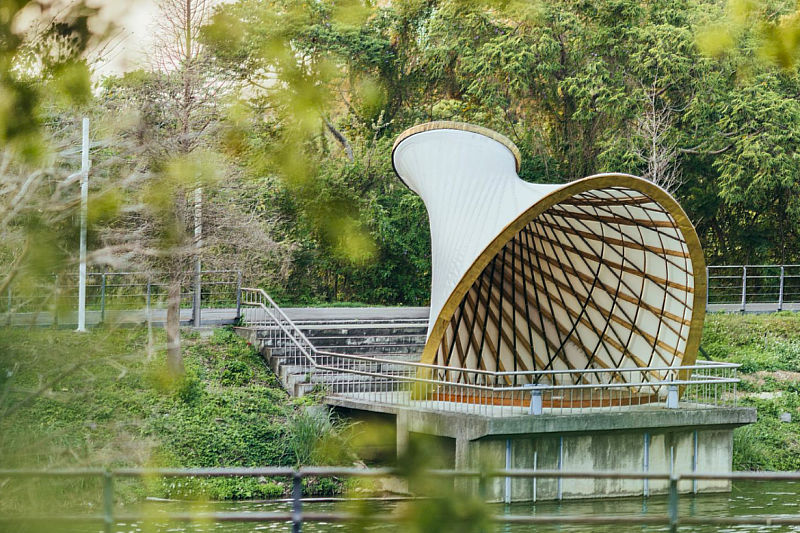
Each project reveals a different dimension of contemporary bamboo architecture. Bridge Cocoon explores material innovation, Bamboo Dome investigates structural possibilities, and MemutAR demonstrates how digital technologies can reshape the way bamboo buildings are assembled and shared across borders. Designed by architect Kristof Crolla, Associate Dean of the Faculty of Architecture at the University of Hong Kong, together with the LEAD research team, the project demonstrates how advanced technologies can redefine the construction process.
The bamboo components were prefabricated by master craftsmen in Bali before being dismantled and shipped to Taiwan. Using augmented reality (AR) technology, local teams were then able to precisely position and reassemble the structure on site.
The project showcases how digital tools can overcome geographic limitations, enabling complex bamboo structures to be replicated with accuracy across different locations. It also offers a glimpse into how future construction industries may combine traditional craftsmanship with digital workflows to improve efficiency and collaboration.
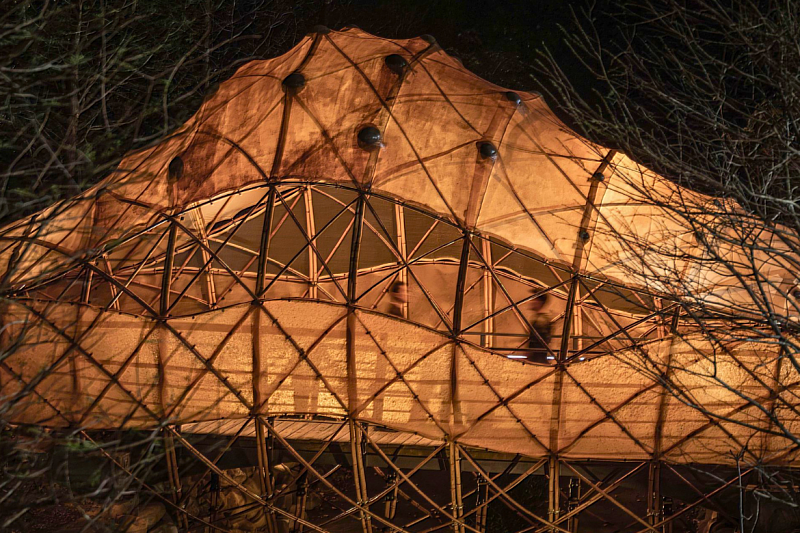
Together, these structures illustrate how bamboo is being reimagined by a new generation of architects, engineers, and designers. Across the NYCU campus, bamboo is no longer viewed simply as a traditional material—it has become a platform for experimentation, collaboration, and new approaches to sustainable living. They demonstrate how a material deeply rooted in local culture can be reinterpreted through engineering innovation, digital manufacturing, and contemporary design.
According to Forestry and Nature Conservation Agency Director-General Hua-Ching Lin, bamboo remains one of Taiwan’s most valuable natural resources. Its rapid growth cycle and strong carbon-sequestration capabilities make it increasingly relevant as societies seek sustainable solutions in response to climate change and net-zero ambitions.
As bamboo applications continue to expand into architecture, public spaces, and everyday environments, NYCU’s campus offers a rare opportunity to witness this transformation firsthand—where a traditional material is helping shape new possibilities for sustainable living and future design.