




- NYCU Brings Global Nursing Leaders Together to Explore the Future of Healthcare in the AI Era
- NYCU Brings AI and Autonomous Vehicle Research to Penghu to Advance Smart Island Governance
- NYCU Vulpes Racing Takes Third Place at Formula Student Taiwan, Sets Sights on Japan
- NYCU Students Win World Championship at IEEE Hardware Computing Competition
- NYCU’s iGEM Team Wins Gold, Adding New Momentum to Global Evolution
NYCU Joins Taiwan Regenerative Medicine Alliance to Advance Next-Generation Healthcare
(中央社訊息服務20260716 10:25:23)Taiwan is strengthening its regenerative medicine ecosystem through a new partnership between the Taiwan Regenerative Medicine Alliance (TRMA) and National Yang Ming Chiao Tung University (NYCU), bringing together expertise in biomedical engineering, artificial intelligence, clinical medicine, and semiconductor technologies to accelerate next-generation healthcare innovation.
The two organizations recently signed a memorandum of understanding (MOU), marking a new phase of collaboration across academia, industry, research institutions, and healthcare providers. Witnessed by the Taiwan Institute of Economic Research (TIER), the agreement aims to build a more integrated innovation ecosystem that translates scientific discoveries into clinical and industrial applications while enhancing Taiwan’s international competitiveness.
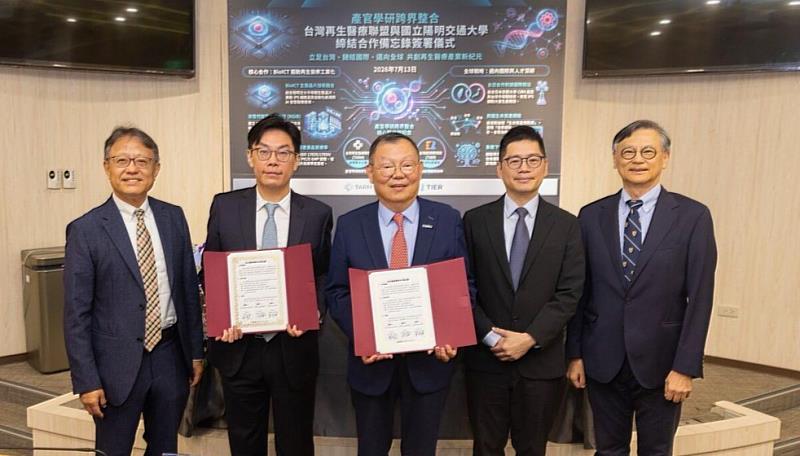
Since the 2021 merger of National Yang-Ming University and National Chiao Tung University, NYCU has combined its strengths in medicine, life sciences, engineering, and information and communication technologies to develop innovative healthcare solutions.
NYCU President Chi-Hung Lin said the university continues to leverage this interdisciplinary foundation to advance smart healthcare, biomedical engineering, and regenerative medicine.
“By integrating engineering, medicine, and digital technologies, NYCU is creating new opportunities for innovation in regenerative medicine,” Lin said. “Through collaboration with industry and research partners, we hope to accelerate technological translation, cultivate future talent, and strengthen Taiwan’s global competitiveness.”
As one of the alliance’s key academic partners, NYCU will contribute expertise in BioICT biomedical chips, AI-enabled healthcare, automated stem cell manufacturing, and translational biomedical research.
Among its flagship technologies is a semiconductor-based BioICT platform that integrates microfluidics, capacitive sensing, temperature control, and microscopic imaging onto a single chip. Designed using Taiwan’s semiconductor manufacturing technologies, the platform enables automated cell quality analysis while improving production efficiency and reducing manufacturing costs.
The technology has already been adopted by the CiRA Foundation at Kyoto University in Japan for automated quality assessment of induced pluripotent stem (iPS) cells, highlighting its potential for international regenerative medicine applications.
A major focus of the partnership will be developing a Next-Generation Intelligent Biobank (NGIB) capable of storing up to 500,000 biological samples.
Unlike conventional biobanks that rely heavily on manual operation, the proposed platform combines fully automated ultra-low-temperature storage with NYCU’s proprietary BioICT Quality Control (QC) Chip and AI-powered predictive maintenance technologies. The system is expected to improve storage efficiency, quality management, and long-term reliability while transforming Taiwan’s semiconductor expertise into advanced biomedical infrastructure for regenerative medicine.
The collaboration will also expand AI-assisted drug discovery through NYCU’s College of Pharmaceutical Sciences, where researchers use biomedical databases and machine learning algorithms to predict interactions between therapeutic compounds and biological targets, helping shorten the early stages of drug development.
In parallel, NYCU Hospital will work toward developing clinical operations that align with international ISO certification and PIC/S Good Manufacturing Practice (GMP) standards, laying the foundation for future international collaboration in regenerative medicine.
One of NYCU’s key contributions to the alliance will be its semiconductor-based biomedical chip technologies.
Developed using Taiwan Semiconductor Manufacturing Company (TSMC)’s standard semiconductor fabrication process, the BioICT platform integrates microfluidics, capacitive sensing, temperature control, and microscopic imaging into a single chip. The technology enables automated cell quality analysis while improving manufacturing efficiency and reducing production costs.
The platform has already been adopted by the CiRA Foundation at Kyoto University in Japan for automated quality assessment of induced pluripotent stem (iPS) cells, demonstrating its potential for international regenerative medicine applications.
The collaboration will also focus on developing a Next-Generation Intelligent Biobank (NGIB) capable of storing up to 500,000 biological samples.
The system will combine fully automated ultra-low-temperature cell storage with NYCU’s proprietary BioICT Quality Control (QC) Chip and AI-powered predictive maintenance technologies.
By reducing reliance on manual handling and improving storage standardization, the platform is expected to enhance the safety, efficiency, and scalability of cell preservation while translating Taiwan’s semiconductor precision manufacturing capabilities into advanced biomedical infrastructure.
NYCU’s College of Pharmaceutical Sciences will contribute AI-assisted drug discovery technologies that combine large-scale biomedical databases with machine learning algorithms to predict interactions between therapeutic compounds and biological targets, helping shorten early-stage drug development.
The partnership also supports the development of international-standard clinical infrastructure at NYCU Hospital, with the long-term goal of achieving ISO certification and PIC/S Good Manufacturing Practice (GMP) compliance for regenerative medicine, positioning the hospital as a potential hub for future Taiwan-Japan clinical collaboration.
Beyond research collaboration, the alliance and NYCU plan to establish a new academic program in regenerative medicine and cell engineering to cultivate the next generation of industry professionals.
The curriculum will include certification courses, advanced technical training, and executive education programs designed to prepare professionals for international standards such as ISO 17034, ISO 20387, and PIC/S GMP requirements for clinical operations and quality management.
Lin said the partnership extends beyond developing next-generation cell therapies and automated manufacturing technologies. “Our goal is also to build an ecosystem that connects academia and industry while cultivating the highly skilled workforce needed to support the future growth of regenerative medicine,” he said.
The TIER described the agreement as an important milestone for Taiwan’s regenerative medicine sector. The institute said. “By strengthening collaboration among academia, industry, government, and research organizations, Taiwan will be better positioned to expand its strategic role in the global regenerative medicine economy.”
Lin said the collaboration represents more than a research partnership. “Our goal is not only to develop next-generation cell therapies and automated manufacturing technologies, but also to build an ecosystem that connects academia and industry while preparing the talent needed to support the future growth of regenerative medicine,” he said.
NYCU and the alliance plan to establish a new academic program in regenerative medicine and cell engineering, accompanied by professional training programs ranging from foundational certification courses to advanced technical and management education. The initiative aims to prepare professionals capable of meeting international standards, including ISO 17034, ISO 20387, and PIC/S GMP requirements for regenerative medicine and cell therapy.
For NYCU, the partnership reflects the university’s commitment to translating interdisciplinary research into real-world healthcare solutions. By combining expertise in medicine, engineering, artificial intelligence, and semiconductor technologies, the university aims to help shape the next generation of regenerative medicine in Taiwan and beyond.