




- NYCU Leads Smart City Innovation Hub, Advancing AI-Driven Urban Governance with Global Partners
- NYCU and NTHU Share Overall Title at the 58th Mei-Chu Games
- NYCU Launches Digital “Introduction to Chinese Medicine” Course for High School Students Across Taiwan
- NYCU Students Win Global Championship at JAXA’s Kibo-RPC Space Robotics Programming Challenge
- NYCU and MUFG Convene Taiwan–Japan–India Semiconductor Conference to Strengthen Regional Value Chains
NYCU Showcases Architectural Futures, Rethinking Urban Resilience and Design
(中央社訊息服務20260318 15:47:28)National Yang Ming Chiao Tung University (NYCU) has launched its annual architecture exhibition, bringing together a year’s worth of student work to explore how design can respond to an increasingly complex and uncertain world.
Titled “Before the Future: Generating Alternative Possibilities in the Present,” the 2026 NYCU Architecture Exhibition runs from March 2 to March 27 at the HaoRan Library B1 Art Space on the university’s Chiaotung campus. Curated under the guidance of Professor Shu-Chang Kung, the exhibition gathers projects from 16 design studios, presenting architecture not as a fixed outcome, but as an evolving inquiry into society, resilience, and the nature of space.
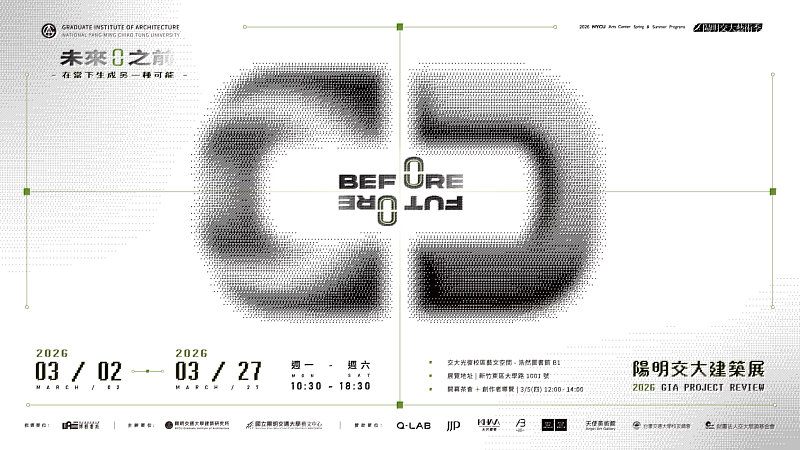
At the heart of the exhibition lies a critical proposition: architecture is inherently shaped by time lag. From concept to construction, the world often changes before a building is realized. Rather than attempting to predict the future, the exhibition frames architecture as a “precursor experiment” — one that operates in the present, navigating constraints, differences, and uncertainties to propose more resilient ways of living.
Each project becomes a speculative probe into what lies “before the future,” inviting viewers to reflect on possibilities that have yet to fully materialize.
The exhibition is structured around five interconnected thematic fields, transforming coursework into a dynamic landscape of ideas:
。Alternative Landscapes reexamines the boundary between nature and the built environment, positioning landscape as a social interface rather than a passive backdrop.
。Alternative Coexistence in Dwelling explores co-living, social housing, and urban regeneration, seeking new forms of intimacy and connection in collective living environments.
。Alternative Resonance of Time engages with historical sites and adaptive reuse, enabling dialogue between past and future through architectural intervention.
。Alternative Consciousness Expansion investigates sensory experience, interactive installations, and the relationship between body, perception, and space.
。Alternative Material Operations experiments with materials, sustainability, and construction logic, opening new possibilities for architectural language in a circular economy.
Together, these themes reflect how emerging architects are pushing beyond disciplinary boundaries to respond to shifting societal conditions.
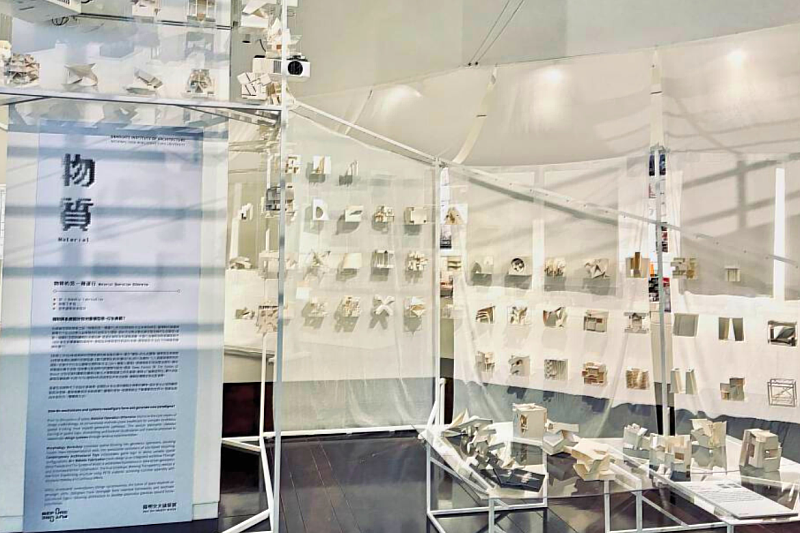
Among the featured works, projects such as “AI + Robotic Construction” integrate data, geometry, and fabrication processes to explore architecture in the age of digital manufacturing. The “Morphology Workshop” reinterprets architectural ideas through geometric operations, transforming models into analytical tools rather than mere representations.
Other projects take a more social turn. In the coexistence section, proposals for intergenerational housing and Continuing Care Retirement Communities (CCRCs) address aging populations and changing family structures, envisioning housing systems that support long-term care and community integration.
A standout project, “DittoCrew,” by student Hu Yu-Hsiang, tackles Taipei’s housing affordability challenges by combining parametric design with public-private development strategies. The proposal earned third place in the 2025 International Student Tall Building Design Competition hosted by the Council on Tall Buildings and Urban Habitat (CTBUH).
The exhibition also features contributions from five leading architecture firms, including KHAA, Q-LAB, JJP Architects & Planners, Kris Yao Artech, and AxB Architecture Studio. Their participation creates a dialogue between academic experimentation and professional practice, allowing visitors to compare, contrast, and connect different visions of architecture’s role in shaping the future.
This collaboration underscores the exhibition’s broader ambition: to position architecture as a shared platform where education, industry, and society converge.
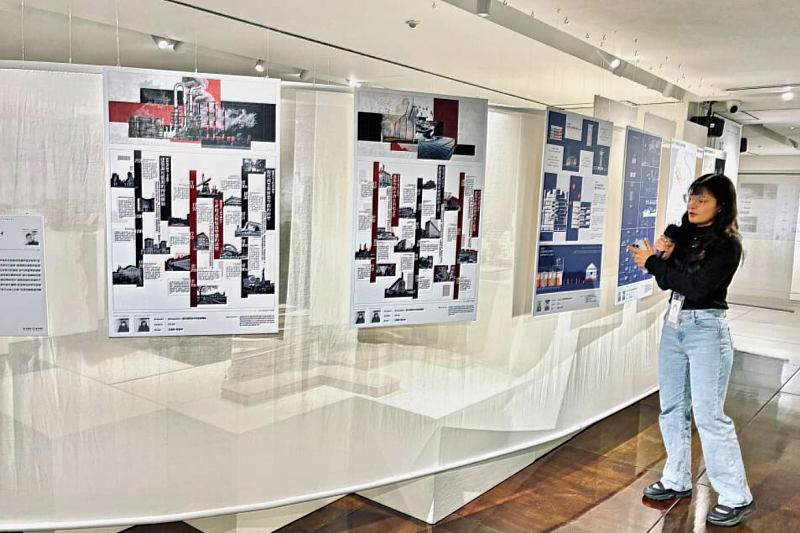
On the second floor, projects under themes such as landscape, time, and consciousness expand the conversation further.
Works like “New Taipei City Library Branch” redefine public libraries as active platforms for knowledge exchange, while “Hsinchu Park Museum/Library” reimagines cultural institutions as inclusive civic spaces. Other installations explore how digital technologies reshape perception, turning space into a medium for sensory and cognitive experience.
Meanwhile, projects addressing energy and infrastructure examine architecture as part of broader global systems — from data centers to supply chain landscapes — prompting new ways of thinking about “non-human” architecture in an era of technological acceleration.
Rather than offering a fixed vision of what lies ahead, the exhibition presents architecture as an ongoing process of inquiry — one rooted in the present, yet constantly reaching toward what could be. In doing so, NYCU positions design not simply as a response to change, but as a way to navigate it — shaping how future cities, communities, and ways of living might emerge.