




- Taiwan–U.S. Biomedical Collaboration: NYCU and NHRI Co-host with UC Irvine to Advance Big Data in Tumor Biology and Immunology
- NYCU Develops Humidity-Resistant Catalyst to Tackle Ozone Pollution in Subtropical Climates
- NYCU Marks 5th Anniversary with Opening Ceremony at Bo-Ai Campus, Showcasing Renewal and Future Vision
- NYCU Hosts GCIEM Summit as Global Experts and Industry Converge on Engineering Medicine and AI
- NYCU Awards Honorary Doctorate to Renowned Photonics Scientist Jia-Ming Liu
NYCU Study Finds Belly Fat May Signal Hidden Heart Failure Risk—Even at Normal Weight
(中央社訊息服務20260423 14:03:17)A research team led by Professor Hao-Min Cheng of the College of Medicine at National Yang Ming Chiao Tung University (NYCU) has found that where fat is stored in the body—rather than how much a person weighs—may be a critical predictor of heart failure risk. The findings show that abdominal fat can significantly increase the likelihood of developing heart failure, even among individuals with a normal body mass index (BMI). The study was presented at the American Heart Association EPI|Lifestyle Scientific Sessions 2026 in Boston.

The study analyzed data from the Jackson Heart Study—one of the largest long-term cohort studies of cardiovascular health among African American populations in the United States—covering 1,998 adult participants. The findings showed that abdominal fat was more strongly associated with heart failure risk than overall body weight. Individuals with larger waist circumferences or higher waist-to-height ratios faced increased risk—even when their BMI remained within a healthy range.
“These findings suggest that BMI alone may not be enough to identify individuals at risk,” said Szu-Han Chen, lead author of the study and a medical student at NYCU. “Monitoring waist size may provide a more sensitive and accessible way to detect hidden cardiovascular risk early.”
Researchers identified inflammation as a major biological pathway connecting abdominal fat and heart failure. Elevated levels of inflammatory markers were associated with a higher likelihood of developing heart failure over time, accounting for approximately one-quarter to one-third of the observed risk.
The findings are consistent with previous research from the American Heart Association, which highlights systemic inflammation as a key contributor to cardiovascular disease.
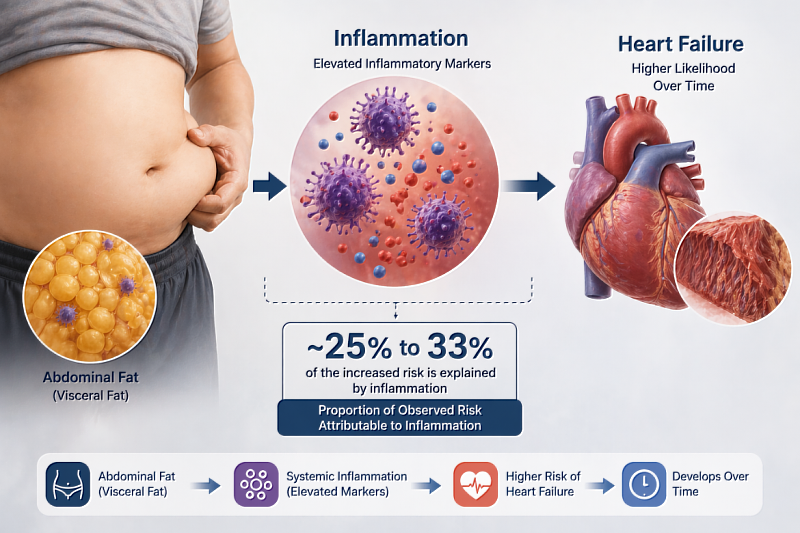
Over a median follow-up period of 6.9 years, 112 participants in the study developed heart failure. Higher levels of abdominal fat and inflammation were consistently associated with increased risk, while BMI alone showed no significant predictive value.
The results suggest that incorporating simple measures such as waist circumference into routine health assessments could improve early detection of cardiovascular risk—particularly for individuals who may appear healthy based on BMI alone.
While further research is needed to explore specific subtypes of heart failure and potential interventions, the study underscores a clear message: the number on the scale may not tell the full story—your waistline could be a more important indicator of future heart health.