




- NYCU AI Team Ranks Among Top Five Worldwide in CVPR 2026 Deepfake Detection Challenge
- NYCU Uses AI and Semiconductor Education to Support Ukrainian Students Reimagine the Future
- NYCU, Academia Sinica, and NTHU Develop “EcoDecibel” Sensors to Map Urban Noise in Real Time
- NYCU Brings Gamified Precision Elderly Care to Hsinchu in New AI-Powered Healthy Aging Initiative
- NYCU and Yang Ming Marine Transport Launch AI Partnership for Smart Shipping and Sustainable Supply Chains
Top Scholars from Taiwan, the U.S., and Korea Gather at NYCU to Advance Cancer Immunology Research
(中央社訊息服務20260603 12:09:19)Leading immunologists and physician-scientists from Taiwan, the United States, and South Korea convened in Taiwan this May for the 2nd Taiwan–Harvard–KAIST Immunology Joint Symposium, an international gathering focused on the latest advances in cancer immunology, neuroimmunology, and translational medicine.
Co-organized by National Yang Ming Chiao Tung University (NYCU), the National Health Research Institutes (NHRI), and Linkou Chang Gung Memorial Hospital, the symposium opened on May 15 at Linkou Chang Gung Memorial Hospital and continued on May 16 at NYCU’s Yangming Campus. Bringing together researchers from NYCU, Harvard Medical School, and the Korea Advanced Institute of Science and Technology (KAIST), the event provided a platform for in-depth discussions on emerging discoveries, clinical applications, and future directions in immunology research.
The symposium highlighted NYCU’s growing international presence in biomedical sciences while underscoring the strength of long-term scientific partnerships among Taiwan, the United States, and South Korea.
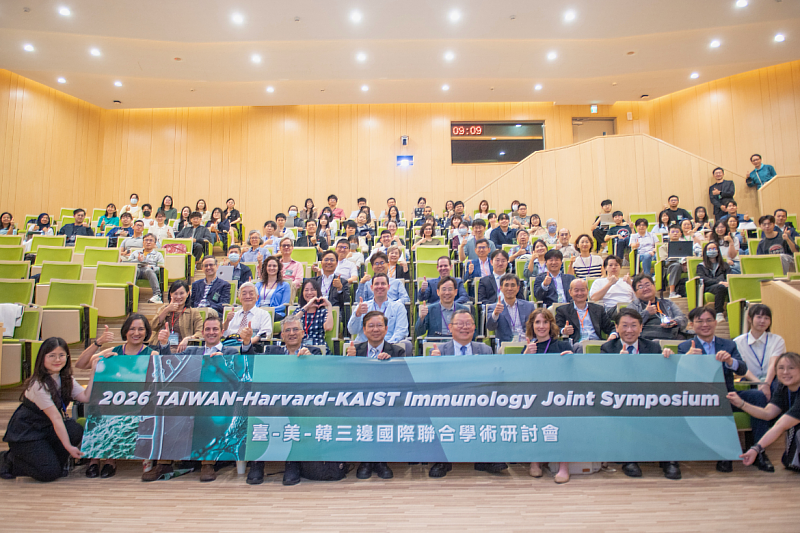
During the opening session at NYCU, Professor Shie-Liang Hsieh, chief organizer of the symposium, reflected on the origins and evolution of the trilateral partnership.
He noted that Dr. Gene Lay, founder and CEO of BioLegend, has long championed global biomedical research through the Laygend Foundation. With the foundation’s support, research funding was provided to Brigham and Women’s Hospital at Harvard Medical School to establish the Gene Lay Institute of Immunology and Inflammation (GLI), which promotes research and therapeutic development in areas such as neurodegenerative disorders, immune-mediated diseases, and cancer.
Building on this foundation, NYCU Vice President Muh-Hwa Yang and NHRI President Shie-Liang Hsieh traveled to Boston in October 2023 to sign a five-year memorandum of understanding with GLI, thereby formally establishing an international research platform to strengthen collaboration in cancer immunology, neuroinflammation, and translational medicine. The partnership integrates research resources, talent development, and academic exchange to enhance Taiwan’s global impact in biomedical science.
In recognition of his contributions to biotechnology innovation and international scientific collaboration, NYCU awarded Dr. Lay an Honorary Doctor of Science degree in October 2024. NYCU President Chi-Hung Lin presented the honor in acknowledgment of Dr. Lay’s achievements in advancing both the biotechnology industry and global academic partnerships.
The collaboration expanded further in May 2025 when KAIST hosted the inaugural Taiwan–U.S.–Korea Trilateral Joint Symposium. Focusing on cancer immunology and the immunology of aging, the event marked the official launch of a long-term framework for scientific collaboration and talent exchange among the three regions.
This year’s symposium brought 19 visiting scholars from the United States and South Korea to Taiwan. Many participants arrived several days early to attend the 2026 International Medical Metabolism Conference, hosted by NHRI from May 13–14, where researchers explored topics ranging from metabolic medicine and immune regulation to nutrition and aging.
The immunology symposium itself drew more than 150 faculty members, researchers, and students to NYCU’s Ho Ying Tsai Memorial Hall. Seventeen invited scholars from Harvard, KAIST, and other leading institutions delivered presentations and engaged in discussions that highlighted the value of international collaboration in addressing complex biomedical challenges.
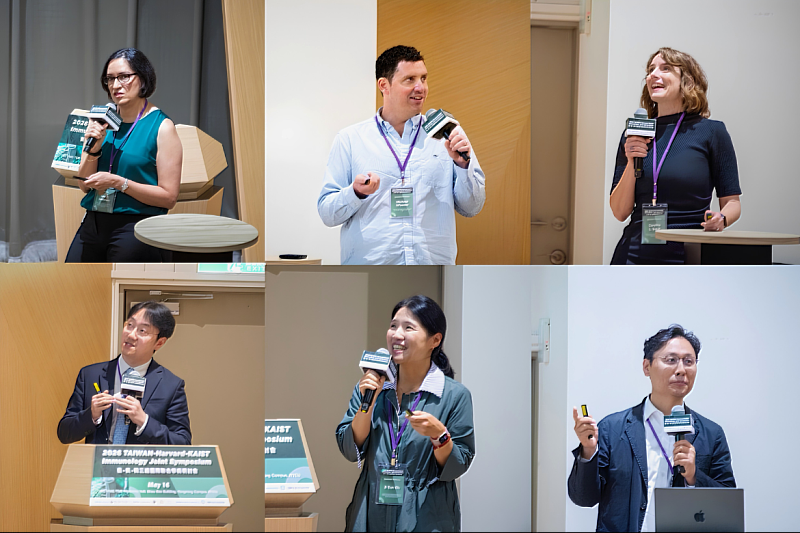
The symposium’s keynote address was delivered by Professor Ana C. Anderson of Harvard Medical School, a leading authority in tumor immunology and T-cell regulation and a pioneer in TIM-3 research.
Anderson recently entered into a three-year research collaboration agreement with NYCU Vice President Muh-Hwa Yang to investigate the tumor microenvironment in early-onset cancers. During her presentation, she shared findings from single-cell RNA sequencing studies of colorectal cancer across different age groups, revealing distinct immune microenvironment characteristics associated with early-onset disease.
Professor Jeong Seok Lee of KAIST followed with research examining spatial changes in the tumor microenvironment during immunotherapy for metastatic gastric cancer and how these changes influence treatment response and drug resistance. Professor Ji Eun Oh, also from KAIST, discussed how abnormal B-cell differentiation affects the durability and diversity of antibody-mediated immune responses in cancer patients.
The symposium’s second session focused on neuroimmunology and inflammatory regulation. Professor Michael Wheeler of Harvard MedicalSchool presented research investigating how communication between the brain and peripheral organs shapes physiological regulation and behavior. Professor Je-Min Choi of Hanyang University examined the activation states and functions of CD4 T cells in neuroinflammatory autoimmune diseases. At the same time, Professor Caroline Sokol of Harvard Medical School discussed emerging insights into the interactions between the nervous and immune systems during allergic inflammatory responses.
Together, the presentations reflected some of the most active and rapidly evolving areas of contemporary immunology research, spanning fundamental biological mechanisms, disease pathology, and potential therapeutic strategies.
The 3rd Taiwan–Harvard–KAIST Immunology Joint Symposium is expected to be held in Boston, continuing the momentum of this growing international partnership.
Organizers anticipate expanding collaborative research in cancer immunology, immunology of aging, neuroinflammation, and related fields. Through sustained academic exchange, joint research initiatives, and talent development programs, the trilateral alliance aims to accelerate scientific discovery and strengthen global biomedical innovation.
For Taiwan, the partnership also represents a valuable opportunity to enhance international visibility and deepen its contributions to the global scientific community, reinforcing its position as an important hub for immunology and translational medicine research.