




- 2026 Taiwan Bamboo Expo Spotlights Bamboo Innovation at NYCU
- NYCU and Phison Partner to Build Campus-Wide AI Compute Governance Platform
- NYCU International Symposium Explores How Future Medicine Will Be Built
- NYCU and TSMC Expand Semiconductor Talent Development Through Summer Courses
- Together Toward Infinite Possibilities: NYCU Celebrates the Class of 2026
NYCU Ranked 49th Globally in THE Sustainability Impact Ratings 2026
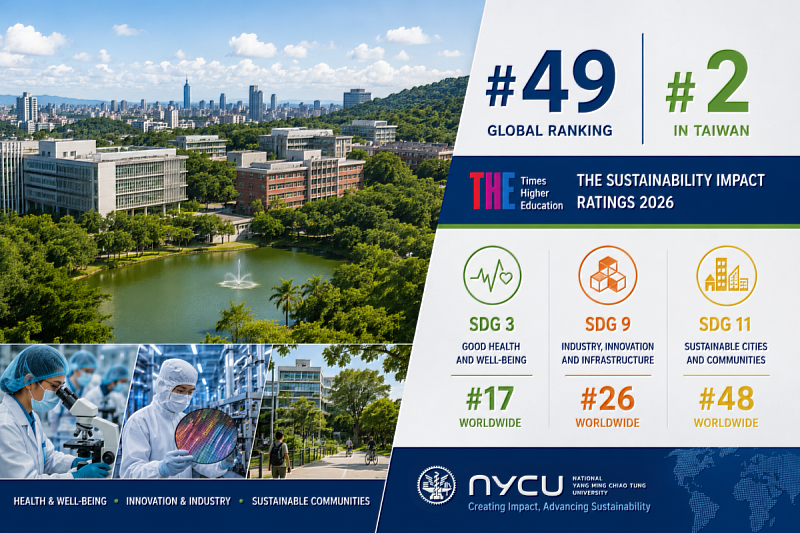
(中央社訊息服務20260625 17:03:27)National Yang Ming Chiao Tung University (NYCU) has been ranked 49th worldwide and second in Taiwan in the 2026 Times Higher Education (THE) Sustainability Impact Rankings. Among the university’s strongest performances were SDG 3 (Good Health and Well-Being), where NYCU ranked 17th globally, SDG 9 (Industry, Innovation and Infrastructure), ranked 26th, and SDG 11 (Sustainable Cities and Communities), ranked 48th.
The THE Sustainability Impact Rankings are among the world’s largest assessments of university contributions to sustainable development. This year’s rankings evaluated 1,646 universities from 116 countries and regions based on the United Nations Sustainable Development Goals (SDGs), measuring institutions across research, teaching, campus operations, community engagement, and global partnerships.
According to NYCU Senior Vice President Chien Chou, the significance of the SDGs lies in their focus on challenges shared by societies worldwide. “Taiwan cannot remain on the sidelines of global sustainability issues,” Chou said. “As one of Taiwan’s leading research universities, NYCU has a responsibility to contribute solutions through education, research, and innovation.”
Chou noted that the value of the THE Sustainability Impact Rankings extends beyond international recognition. More importantly, they provide a common framework that enables universities worldwide to assess and strengthen their sustainability efforts.
Speaking after attending the THE Global Sustainable Development Congress in Indonesia, Chou observed that many participating institutions were less concerned with improving rankings than with exploring how sustainability could be embedded into research, teaching, university governance, and public engagement. “The goal is not simply to achieve better rankings,” she said. “The goal is to make sustainability part of the culture and decision-making process of a university.”
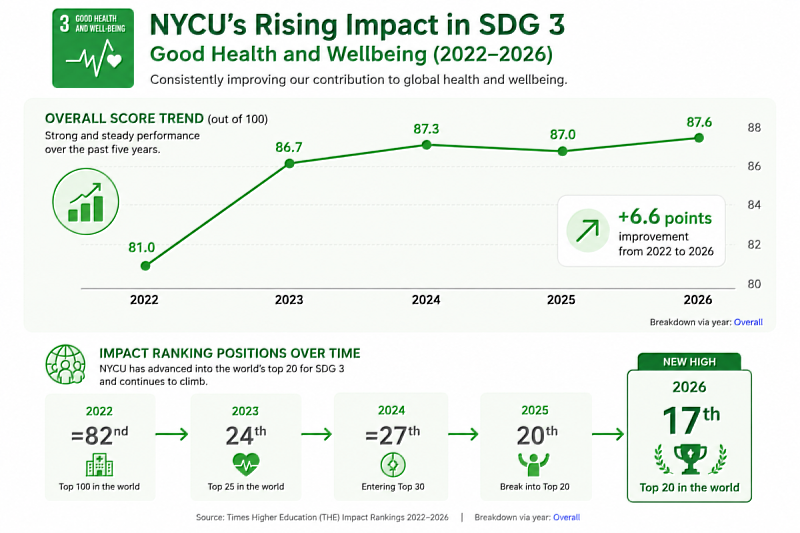
As one of Taiwan’s few comprehensive research universities with strengths in both medicine and engineering, NYCU has expanded initiatives in smart healthcare, precision medicine, healthy aging, and digital health technologies. Researchers across the university are developing AI-assisted clinical decision systems, smart ward-round technologies, and precision healthcare applications while advancing research in cancer treatment, neurodegenerative diseases, and regenerative medicine.
The university’s commitment to global health collaboration was also reflected in the 2026 NYCU College of Medicine International Symposium: A New Ecosystem for Medical Research, held in June. The event brought together nearly 200 scholars, clinicians, and researchers from Taiwan, the United States, Japan, Singapore, and other countries to explore how artificial intelligence, digital healthcare, and interdisciplinary research are reshaping the future of medicine.
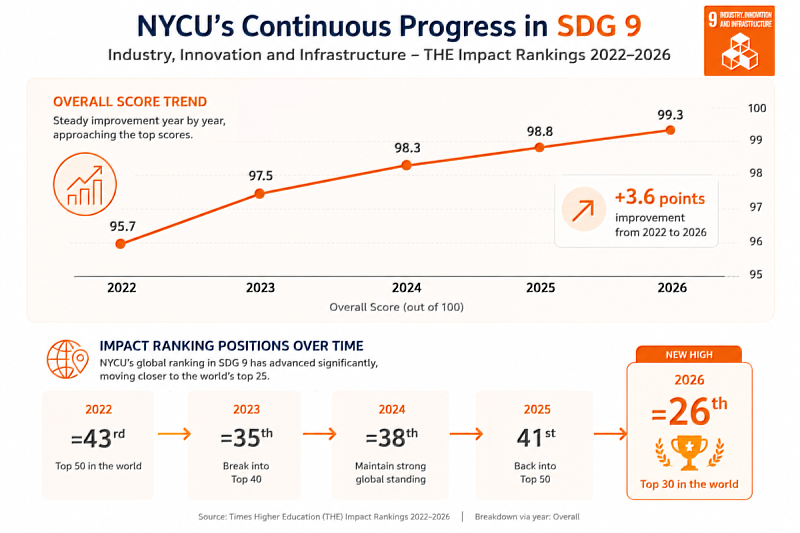
For decades, the university has served as one of Taiwan’s key talent pipelines for the semiconductor and high-tech sectors. NYCU maintains close partnerships with industry leaders, including TSMC, MediaTek, and NVIDIA. This year, NYCU and TSMC jointly launched a summer semiconductor program that offers specialized courses to university students nationwide, providing broader access to semiconductor knowledge and practical training while helping to address the growing global demand for advanced technology talent.
Beyond talent development and research, the university has also begun examining emerging sustainability questions associated with artificial intelligence. As AI models continue to grow in scale, the management and allocation of computing resources have become increasingly important challenges for universities and research institutions worldwide.
To address this issue, NYCU recently partnered with Phison Electronics to establish a campus-wide AI heterogeneous computing resource management platform. The system enables intelligent scheduling of GPUs and other computing resources, improving utilization efficiency while exploring new approaches to compute governance—a field that seeks to make advanced computing infrastructure more accessible, efficient, and sustainable.
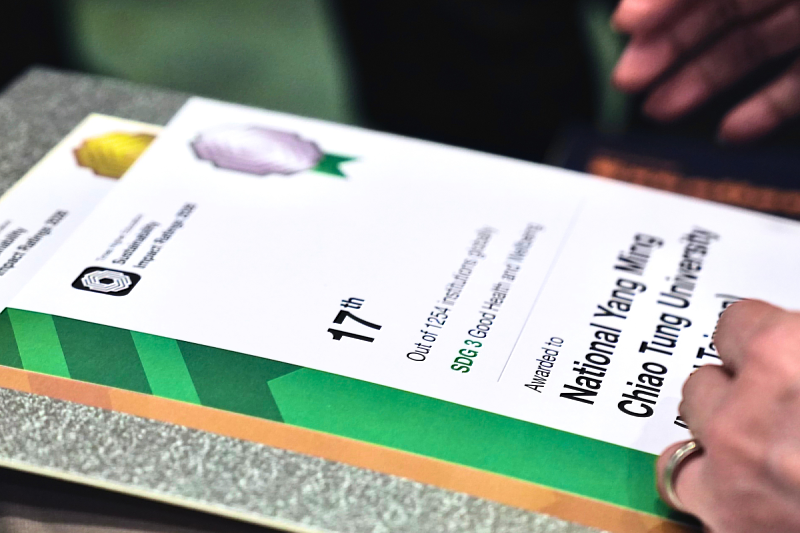
For NYCU, the latest ranking represents more than international recognition. It also serves as a benchmark for evaluating long-term progress in sustainability governance. In recent years, sustainability initiatives at the university have evolved from isolated projects into institution-wide efforts supported by administrative units, academic departments, faculty members, students, and researchers.
Ding-Han Wang, Associate Director of NYCU’s Office of Sustainability and Social Responsibility, said one of the university’s most significant changes has been the growing integration of sustainability across different areas of campus life. Faculty members are incorporating SDGs into research and teaching. Students are participating in University Social Responsibility (USR) projects and community engagement initiatives. Administrative units are developing new policies and governance mechanisms that align with sustainability goals.
According to Wang, achievements in smart healthcare, artificial intelligence, semiconductor technology, and net-zero sustainability collectively contributed to NYCU’s strong performance in this year’s rankings. “International rankings should not be the destination,” Wang said. “They are the result of sustained efforts. By continuing to strengthen collaboration across the university and building more comprehensive systems and mechanisms, NYCU can further expand its positive impact on society and contribute to sustainable development on a global scale.”