




- NYCU Honors Six Distinguished Alumni in Student-Led Ceremony Showcasing Cross-Sector Innovation
- NYCU Showcases Architectural Futures, Rethinking Urban Resilience and Design
- NYCU Leads Smart City Innovation Hub, Advancing AI-Driven Urban Governance with Global Partners
- NYCU and NTHU Share Overall Title at the 58th Mei-Chu Games
- NYCU Launches Digital “Introduction to Chinese Medicine” Course for High School Students Across Taiwan
NYCU Partners with HHRI and RPI to Develop High-Speed Micro-LED Quantum Random Number Generator
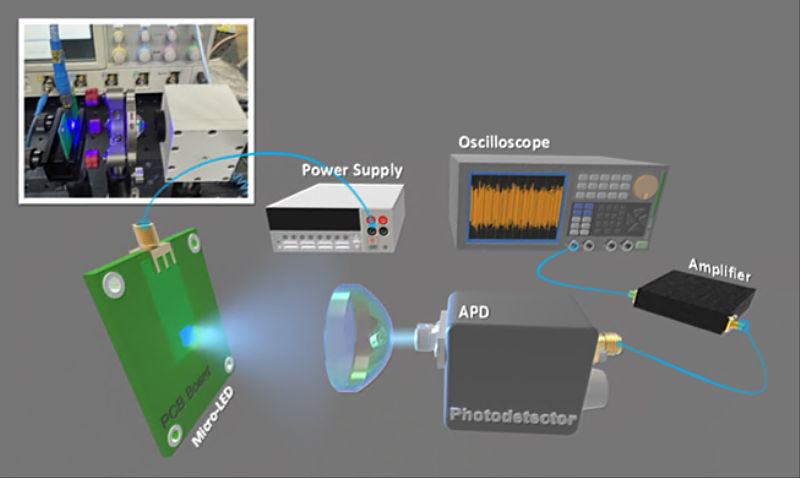
(中央社訊息服務20260326 09:52:08)As display technologies continue to advance, Micro-LED is emerging as a transformative force across the semiconductor and communications industries. A research team led by the Semiconductor Research Institute of the Hon Hai Research Institute (HHRI), in collaboration with National Yang Ming Chiao Tung University (NYCU) and Rensselaer Polytechnic Institute (RPI), has developed a high-speed, scalable quantum random number generator (QRNG) based on indium gallium nitride (InGaN) Micro-LED arrays.
The breakthrough leverages the intrinsic quantum randomness of spontaneous emission in Micro-LEDs, offering a compact and energy-efficient solution for next-generation secure communications and photonic systems. The findings have been published in the IEEE Photonics Journal.

Traditional QRNG systems have long been constrained by low data rates and limited integration capabilities. By harnessing the quantum entropy generated from Micro-LED spontaneous emission, the research team successfully overcame these bottlenecks.
The newly developed system achieves data transmission speeds of up to 12.5 Gb/s, marking a significant advancement over existing technologies and setting a new benchmark for high-speed quantum random number generation.
Micro-LED technology offers key advantages including high bandwidth, low power consumption, and compact size. Unlike conventional laser-based systems that rely on bulky external optical components, Micro-LEDs are highly compatible with chip-scale integration.
These properties unlock a wide range of cross-disciplinary applications:
• Secure communications for 6G and low-Earth orbit (LEO) satellites
Micro-LED devices can simultaneously transmit data and generate true random numbers, enabling “encrypt-as-you-transmit” architectures. This integrated approach is expected to play a critical role in future 6G networks, satellite communications, and fintech security systems.
• Next-generation active optical cables (AOC) for AI data centers
As AI-driven workloads continue to surge, data centers face increasing demands for high-speed, energy-efficient interconnects. Micro-LED arrays enable parallel data transmission through hundreds of microchannels, significantly reducing power consumption compared to traditional laser-based optical modules. At the same time, they offer high reliability comparable to copper cables while supporting longer transmission distances—meeting the needs of future gigawatt-scale AI infrastructure.
The research was led by Professor Hao-Chung Kuo, Director of the Semiconductor Research Institute at HHRI and Chair Professor at NYCU, alongside Dr. Yu-Heng Hong and researcher Yun-Han Chang. The NYCU team included Professor Chun-Liang Lin and Distinguished Professor Chi-Wai Chow, working in collaboration with Chair Professor Boon S. Ooi from RPI.
The project also received strong support from Taiwan’s National Science and Technology Council (NSTC).
This achievement highlights Taiwan’s growing leadership in quantum information science and optical communications. By combining low cost, low power consumption, and miniaturized design, Micro-LED-based QRNG technology lays the groundwork for future single-chip, multi-channel quantum random number generation systems.
Beyond secure communications, the technology is expected to accelerate advancements in quantum encryption, probabilistic AI models, and high-performance secure networks—pushing forward the global adoption of next-generation digital infrastructure.