




- NYCU and Changhua County Launch Smart Agriculture App to Help Farmers Monitor Crops with AI
- NYCU Team Wins Taiwan Title at Red Bull Basement, Heads to Silicon Valley for Global Finals
- NYCU Study Finds Belly Fat May Signal Hidden Heart Failure Risk—Even at Normal Weight
- Taiwan–U.S. Biomedical Collaboration: NYCU and NHRI Co-host with UC Irvine to Advance Big Data in Tumor Biology and Immunology
- NYCU Develops Humidity-Resistant Catalyst to Tackle Ozone Pollution in Subtropical Climates
NYCU Partners with Kneron to Advance Edge AI Education and Real-World Deployment
(中央社訊息服務20260504 16:21:15)National Yang Ming Chiao Tung University (NYCU) announced April 30 that it has received a donation of three high-performance KNEO 300 AI systems from Kneron, marking a new step in strengthening education and research in generative artificial intelligence, large language models (LLMs), and edge computing.
The collaboration aims to narrow the gap between AI model development and real-world deployment, enabling students and researchers to move beyond cloud-based training toward system integration and on-device implementation.
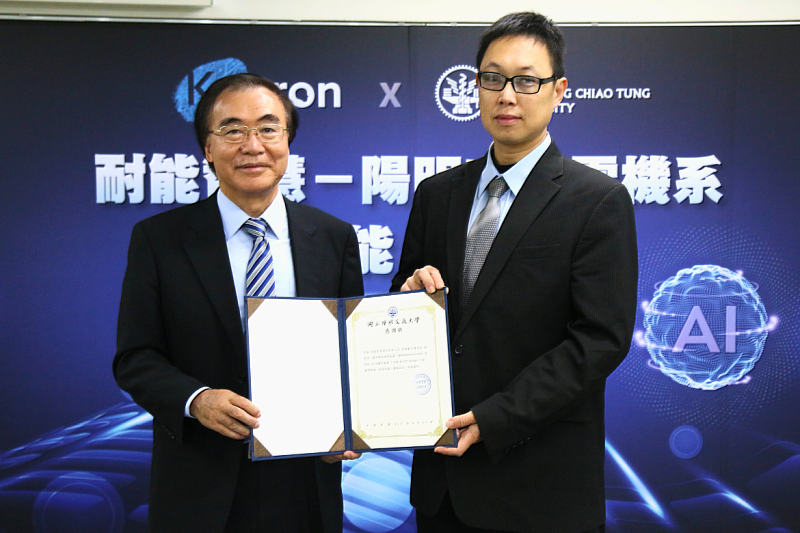
With the new equipment in place, NYCU will expand its AI curriculum to include hands-on training in LLM inference and optimization, generative AI application development, and key techniques such as model quantization and knowledge distillation. Students will also be able to deploy models directly onto edge devices, testing real-time performance in practical scenarios.
NYCU Senior Vice President Jenn-Hwan Tarng said the evolution of artificial intelligence is shifting beyond a singular focus on computing power toward system architectures that balance energy efficiency, latency, and deployment flexibility. For universities, he added, the priority is not only access to high-performance computing, but also infrastructure that supports next-generation AI applications.
“The introduction of a low-power, edge-deployable AI platform represents a critical step toward a cloud-edge collaborative architecture,” Tarng said.
Albert Liu, founder and CEO of Kneron, said the rapid rise of generative AI and large models is reshaping industry demand—shifting attention from sheer computing scale to efficiency, energy consumption, and deployability.
“AI will no longer exist only in the cloud,” Liu said. “It will increasingly move into edge devices and real-world environments. The KNEO 300 is designed to support large language models and generative AI workloads at significantly lower power consumption than traditional GPUs, while providing a practical platform for deployment.”
Wei-Cheng Chou, founder and CEO of Innovedus, emphasized that as AI technologies mature, competitive advantage is shifting from algorithms to talent capable of rapid real-world implementation. He noted that gaps remain between training and deployment—particularly in edge AI—highlighting the importance of industry–academia collaboration.
Innovedus, a strategic partner backed by Kneron, plans to work with NYCU’s Department of Electrical and Computer Engineering to launch an AI workshop for incoming students, accelerating the development of application-oriented AI talent. The initiative will focus on AIoT applications powered by Kneron’s neural processing units (NPUs).
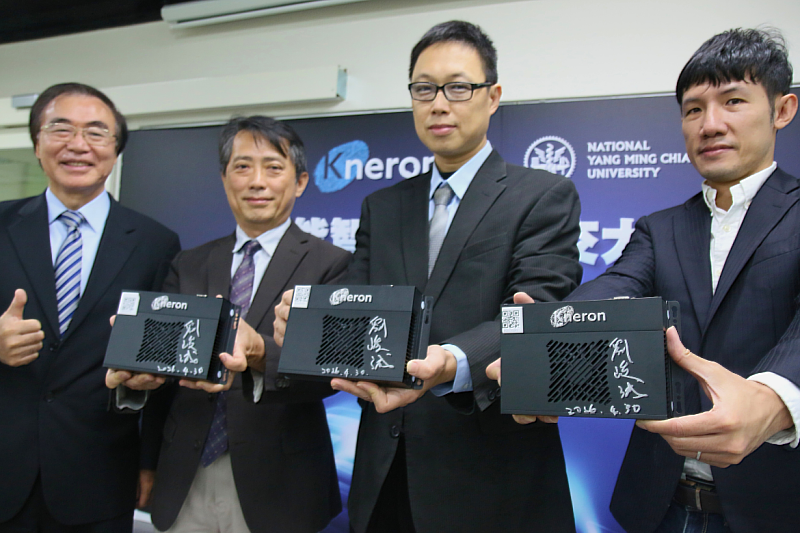
Kai-Ten Feng, chair of NYCU’s Department of Electrical and Computer Engineering, said the systems will be integrated into courses such as Introduction to Artificial Intelligence, Large Language Models, and Generative AI. Students will gain hands-on experience in model optimization and deployment, cultivating cross-disciplinary expertise spanning both software and hardware.
For research teams, the platform will also support validation of emerging technologies—including generative AI, personalized models, and embodied AI—across key metrics such as inference efficiency, energy consumption, and deployment cost. The infrastructure is expected to play a pivotal role in translating theoretical research into real-world applications.
As generative AI moves from centralized cloud systems to distributed edge devices, the partnership is seen as a strategic step for academia to strengthen its capacity for real-world AI deployment and to better align with evolving industry needs.