




- NYCU Builds One of Taiwan’s Most Complete Virtual Campuses in Minecraft
- NYCU Study Redefines Battery Design, Boosting Capacity by 167% for Next-Generation EVs
- NYCU Honors Six Distinguished Alumni in Student-Led Ceremony Showcasing Cross-Sector Innovation
- NYCU Partners with HHRI and RPI to Develop High-Speed Micro-LED Quantum Random Number Generator
- NYCU Showcases Architectural Futures, Rethinking Urban Resilience and Design
NYCU Partners with GWOXI and PODAK to Advance Automated Stem Cell Manufacturing Platform
(中央社訊息服務20260401 09:57:35)As Taiwan enters the first year of implementing its landmark regenerative medicine legislation in 2026, National Yang Ming Chiao Tung University (NYCU) has taken a leading role in a major industry–academia partnership aimed at accelerating the development of next-generation cell therapies.
On March 27, NYCU signed a memorandum of understanding (MOU) with leading stem cell developer Gwo Xi Stem Cell Applied Technology Co., Ltd. (GWOXI) and electronics distributor-turned-biotech player PODAK International Corp., marking a milestone collaboration to build an advanced automated stem cell manufacturing platform.
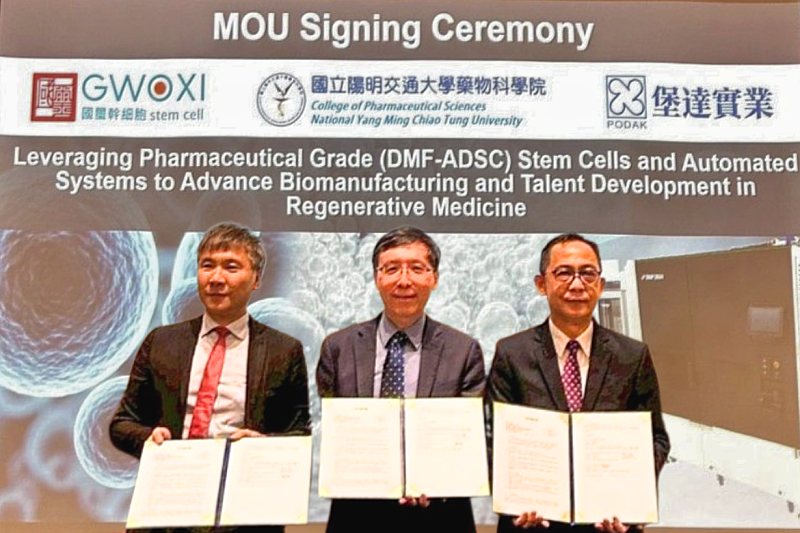
The partnership underscores strong industry confidence in NYCU’s regenerative medicine research capabilities. Led by the university’s College of Pharmaceutical Sciences, the collaboration integrates:
。Clinical-grade stem cell technologies from GWOXI, including U.S. FDA Drug Master File (DMF)-registered adipose-derived stem cells
。Fully automated cell production systems introduced by PODAK from Japan
。NYCU’s strengths in AI-driven drug discovery, data platforms, and translational research
Together, the three parties aim to develop a next-generation automated stem cell processing platform to accelerate the transition from laboratory research to scalable, industrial-level production.
The signing ceremony, held at NYCU, coincided with the “2026 Conference on Diagnostics, Therapeutics and Regenerative Medicine,” where international experts witnessed the agreement.
GWOXI Chairman Ming-Hsi Chuang noted that early integration of industry-grade standards is essential for translating academic innovation into real-world applications. By providing FDA DMF-registered clinical-grade stem cells, the company aims to support NYCU as a core R&D platform and help align Taiwan’s regenerative medicine sector with global regulatory pathways.
PODAK Chairman Chia-Yu Chen highlighted the introduction of Japan’s latest automated cell culture and monitoring system. The platform enables closed, sterile production environments with AI-powered imaging, allowing 24/7 monitoring and standardized large-scale cell expansion—key to ensuring consistency and quality across batches.
Professor Chi-Ying Huang, Dean of NYCU’s College of Pharmaceutical Sciences, emphasized the university’s role as a bridge between academia and industry.
Leveraging proprietary drug databases and AI-based screening technologies, NYCU can predict drug–target interactions and significantly shorten development timelines. With added industry support, the university will focus on designing next-generation cell therapies and building automated production workflows, while also cultivating talent for Taiwan’s growing biotech sector.
The collaboration signals a broader shift in Taiwan’s regenerative medicine landscape—from early-stage research to industrial-scale production.
By combining modular manufacturing systems, clinical-grade materials, and automated technologies, the alliance is expected to establish a resilient, scalable supply chain for cell-based therapies. Industry observers note that such a model could not only serve domestic hospitals and clinics, but also position Taiwan to export integrated “cell factory” solutions across the Asia-Pacific region.
As global demand for stem cell therapies continues to grow, NYCU’s leadership in this cross-sector initiative highlights its expanding role in shaping the future of biomedical innovation and industrial translation.