




- NYCU Partners with Kneron to Advance Edge AI Education and Real-World Deployment
- NYCU and Changhua County Launch Smart Agriculture App to Help Farmers Monitor Crops with AI
- NYCU Team Wins Taiwan Title at Red Bull Basement, Heads to Silicon Valley for Global Finals
- NYCU Study Finds Belly Fat May Signal Hidden Heart Failure Risk—Even at Normal Weight
- Taiwan–U.S. Biomedical Collaboration: NYCU and NHRI Co-host with UC Irvine to Advance Big Data in Tumor Biology and Immunology
Matsu’s “Blue Tears” Inspire NYCU Breakthrough in Next-Generation Luminescent Materials
(中央社訊息服務20260506 12:29:54)The glowing blue waves known as the “Blue Tears” of the Matsu Islands attract thousands of visitors each year, turning Taiwan’s offshore coastline into a dreamlike sea of light. Now, the natural phenomenon has inspired researchers at National Yang Ming Chiao Tung University (NYCU) to develop a new class of non-toxic, heavy-metal-free luminescent materials that could pave the way for future display, sensing, and wearable technologies.
The study was led by Associate Professor Ming-Chia Li from NYCU’s Department of Biological Science and Technology. Inspired by the mysterious blue glow produced by marine microorganisms, Li’s team discovered a soft, transparent silicone material capable of emitting blue fluorescence when stretched or compressed. The findings were published in the international journal JACS Au as part of a collaborative study between NYCU and Associate Professor Tomoyasu Hirai’s research team at Osaka Institute of Technology in Japan.
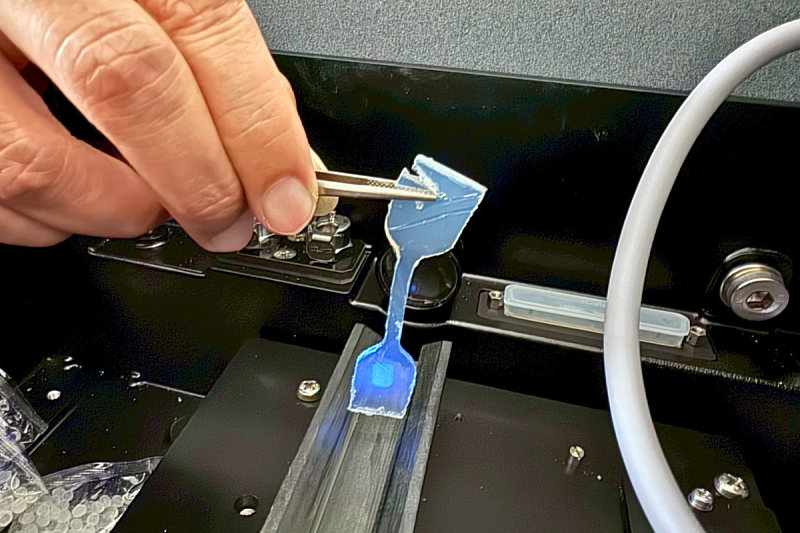
The breakthrough emerged unexpectedly during laboratory testing. While experimenting with newly developed silicone-based materials, graduate students in Li’s lab noticed that the flexible material began emitting light under mechanical stress. The phenomenon immediately reminded the researchers of Matsu’s iconic Blue Tears — a natural bioluminescent display created when microscopic marine organisms emit light after being disturbed by ocean waves.
Unlike traditional luminescent materials, the silicone itself does not inherently glow. Instead, fluorescence is generated when specific molecules within the material come into closer proximity, forming clustered structures.
Li’s team compared the process to dancers gathering on a ballroom floor. As the molecules gradually approach one another, they rotate and move in coordinated patterns like a waltz, allowing light to emerge and travel through the material. Researchers say the mechanism represents an entirely new strategy for producing light, opening the door to flexible, environmentally friendly optical materials.
One of the material’s most significant features is its ability to generate circularly polarized light (CPL), a key technology widely regarded as critical for next-generation 3D imaging and advanced display systems. The research team said the soft, stretchable material could eventually be applied to optoelectronic displays, biomedical imaging sensors, and wearable electronics.
Current 3D display systems typically rely on external glasses to create depth perception. CPL-based materials, however, can emit rotating light directly, potentially enabling more natural and immersive three-dimensional visuals without additional viewing equipment. Researchers also noted that the technology could help reduce energy consumption while enabling future electronic devices to become thinner, lighter, and more flexible.
The study highlights Taiwan’s growing capabilities in advanced polymer and optical materials research while pointing toward new possibilities for sustainable display technologies and next-generation biosensing applications.