




- Matsu’s “Blue Tears” Inspire NYCU Breakthrough in Next-Generation Luminescent Materials
- NYCU Partners with Kneron to Advance Edge AI Education and Real-World Deployment
- NYCU and Changhua County Launch Smart Agriculture App to Help Farmers Monitor Crops with AI
- NYCU Team Wins Taiwan Title at Red Bull Basement, Heads to Silicon Valley for Global Finals
- NYCU Study Finds Belly Fat May Signal Hidden Heart Failure Risk—Even at Normal Weight
NYCU and Purdue Launch Global Semiconductor Academy to Advance AI and Chip Talent Development
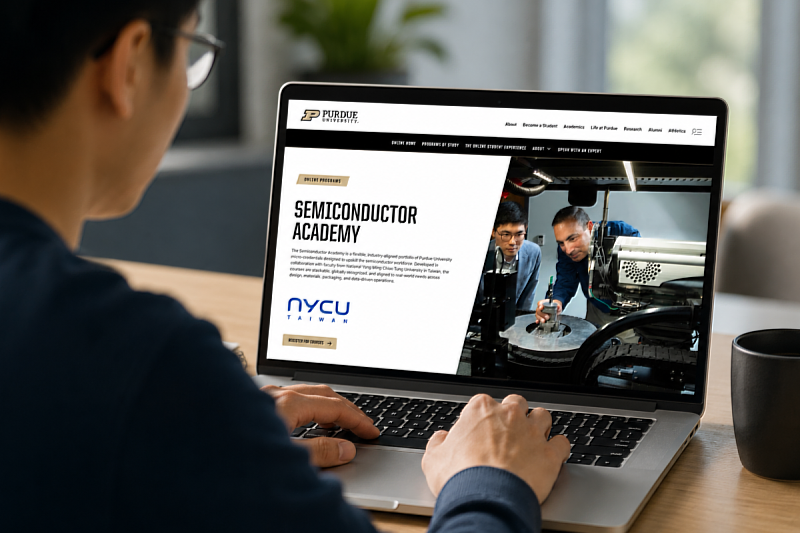
(中央社訊息服務20260507 14:14:32)As the global semiconductor race accelerates in the AI era, National Yang Ming Chiao Tung University (NYCU) and Purdue University have jointly launched the Semiconductor Academy, a new online professional education initiative designed to cultivate next-generation semiconductor talent and expand access to industry-focused learning worldwide.
The collaboration brings together two institutions located at the heart of critical semiconductor ecosystems — Taiwan, home to the world’s most advanced chip manufacturing industry, and the United States, a global leader in semiconductor research, design, and innovation. Developed jointly by NYCU and Purdue, the Semiconductor Academy will offer flexible online courses covering key areas across the semiconductor supply chain, including chip design for AI, semiconductor materials and devices, advanced packaging, reliability, IC design, EDA, and semiconductor industry management.
The program is designed for working professionals, engineers, and learners seeking to deepen their expertise or enter the rapidly evolving semiconductor field. Courses will be delivered online in a modular, stackable format, allowing learners to tailor their studies to their professional goals and industry needs.
As one of Taiwan’s leading universities in electrical engineering, computer science, photonics, AI, and semiconductor research, NYCU has long played a central role in nurturing talent for Taiwan’s semiconductor industry and the Hsinchu Science Park ecosystem.
Through the Semiconductor Academy, NYCU faculty will contribute academic expertise and real-world industry perspectives drawn from Taiwan’s globally influential semiconductor ecosystem, offering international learners a unique window into the technologies and manufacturing practices shaping the future of chips and AI computing.
“Semiconductor innovation requires a deep understanding of the entire technology stack,” said Mark Lundstrom, Don and Carol Scifres Distinguished Professor of Electrical and Computer Engineering at Purdue University. “By bringing together the strengths of both Purdue and NYCU, the Semiconductor Academy provides learners with a rigorous, globally informed perspective on the technologies shaping the future of the industry.” The collaboration also reflects NYCU’s broader internationalization strategy and its commitment to strengthening global partnerships in semiconductors, AI, and emerging technologies.
According to Purdue, the Semiconductor Academy is part of a broader expansion of semiconductor professional education aimed at addressing rising workforce demands across the global chip industry. Each course in the academy will feature approximately 2 hours of focused learning content and be accessible through flexible online formats. The academy will also be featured on SEMI University (SEMI U), a global digital learning platform serving semiconductor professionals and organizations worldwide.
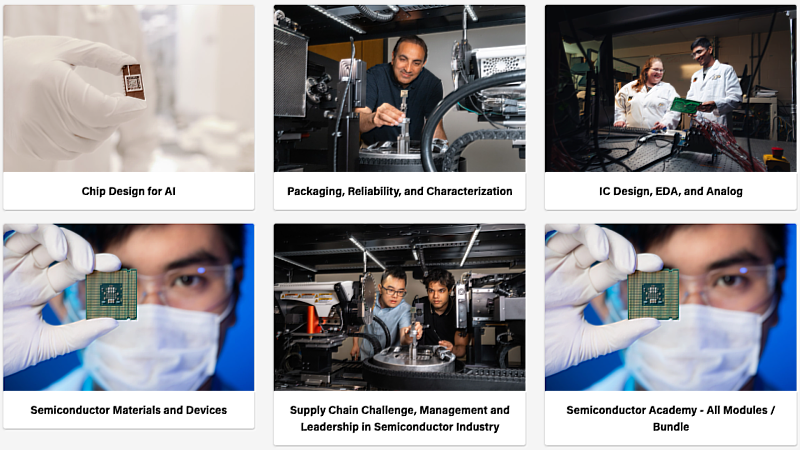
Topics planned for the initial course offerings include:
。Chip Design for AI
。Packaging, Reliability and Characterization
。IC Design, EDA and Analog
。Semiconductor Materials and Devices
。Supply Chain Management and Leadership in the Semiconductor Industry
Additional semiconductor professional education courses developed by Purdue are expected to launch in summer 2026, including transistor fundamentals, nanolithography, RF design, and data analysis for semiconductor applications. The launch ceremony for the Semiconductor Academy was held via livestream between Purdue and NYCU, underscoring the growing importance of international collaboration in building the future semiconductor workforce.