




- NYCU Student Rocket Team Completes Full Mission at World’s Largest Rocket Competition
- NYCU and Mackay Memorial Hospital Publish Study on Brainwave Monitoring During General Anesthesia
- NYCU Joins Taiwan Regenerative Medicine Alliance to Advance Next-Generation Healthcare
- NYCU Brings Global Nursing Leaders Together to Explore the Future of Healthcare in the AI Era
- NYCU Brings AI and Autonomous Vehicle Research to Penghu to Advance Smart Island Governance
NYCU, Military Academy Partner to Prepare the Next Generation of AI-Ready Military Leaders
(中央社訊息服務20260723 12:08:22)Artificial intelligence is transforming not only how wars are fought, but also how future military leaders are educated. As autonomous systems, cybersecurity and data-driven decision-making become increasingly central to modern defense, military academies around the world are looking beyond traditional training to cultivate officers with strong technological capabilities.
Responding to this shift, the Republic of China Military Academy and National Yang Ming Chiao Tung University (NYCU) signed a strategic alliance agreement on July 22 to strengthen collaboration in defense technology, interdisciplinary education and talent development. Facilitated by Stan Shih, chairman of the StanShih Foundation, the partnership brings together one of Taiwan’s premier military academies and one of its leading research universities to prepare future officers for an increasingly intelligent and technology-driven security environment.
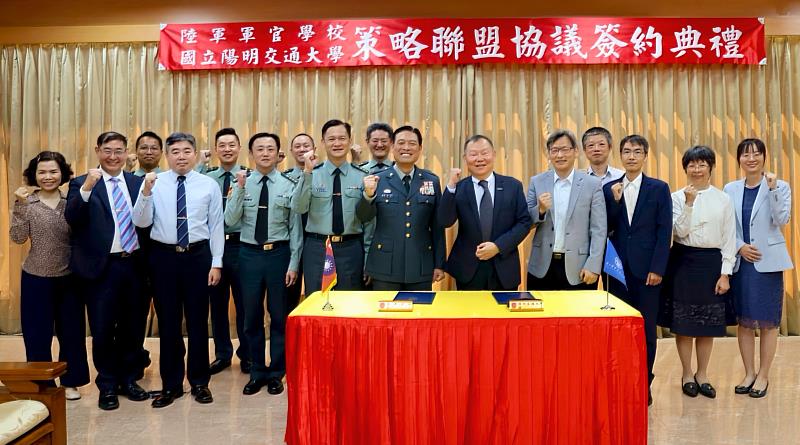
The collaboration focuses on technologies expected to shape the future of defense, including artificial intelligence (AI), unmanned aerial systems (UAS), big data analytics, cybersecurity and intelligent control.
Through cross-institutional course enrollment, joint research projects, faculty and student exchanges, academic seminars and talent development initiatives, the two institutions will combine NYCU’s research strengths with the Military Academy’s practical training to create a more integrated educational model.
The partnership reflects a growing international trend in which universities and defense institutions work together to accelerate innovation while preparing talent capable of navigating rapidly evolving technological challenges.
As one of Taiwan’s leading research universities, NYCU has established internationally recognized strengths in engineering, artificial intelligence, information and communications technology, semiconductor research and intelligent systems.
By connecting these academic capabilities with defense education, the university hopes to expand opportunities for interdisciplinary collaboration while translating research into practical applications that support future national defense and security needs.
The alliance also provides new opportunities for faculty members and students from both institutions to collaborate on emerging technologies, encouraging innovation across disciplinary boundaries.
A key component of the agreement is the establishment of a dual bachelor’s degree program. Students who complete the academic requirements of both institutions will be eligible to earn bachelor’s degrees from both the Republic of China Military Academy and NYCU. The program combines military leadership education with advanced engineering and technology training, enabling graduates to develop broader interdisciplinary expertise while enhancing their future career competitiveness.
As military operations become increasingly supported by AI, autonomous platforms and digital technologies, the program is designed to cultivate officers capable of integrating technological innovation with strategic leadership and systems thinking.
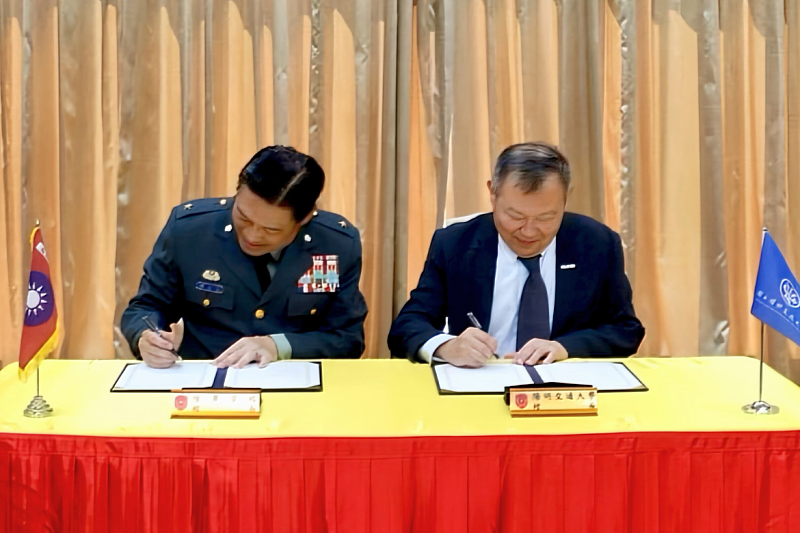
Maj. Gen. Fang-Jung Tan, president of the Republic of China Military Academy, said technological innovation has become a defining element of future defense capabilities. He said the partnership with NYCU represents an important step toward integrating military education with scientific and technological advancement, helping cultivate officers equipped with modern operational thinking, advanced technology applications and systems integration expertise.
For NYCU, the agreement represents another step in strengthening collaboration between academia and society. By connecting higher education with emerging national priorities, the university aims to contribute not only to scientific discovery, but also to the development of talent capable of addressing the complex challenges of an increasingly digital world.