




- NYCU, Military Academy Partner to Prepare the Next Generation of AI-Ready Military Leaders
- NYCU Student Rocket Team Completes Full Mission at World’s Largest Rocket Competition
- NYCU and Mackay Memorial Hospital Publish Study on Brainwave Monitoring During General Anesthesia
- NYCU Joins Taiwan Regenerative Medicine Alliance to Advance Next-Generation Healthcare
- NYCU Brings Global Nursing Leaders Together to Explore the Future of Healthcare in the AI Era
HHRI and NYCU Unveil Silicon Photonic Breakthrough for Next-Generation AI Data Centers
(中央社訊息服務20260728 12:29:39)As artificial intelligence models become larger and more computationally demanding, the next bottleneck in AI is no longer processing power alone—it is how quickly massive amounts of data can move between chips, servers and entire data centers.
Researchers at National Yang Ming Chiao Tung University (NYCU) and the Hon Hai Research Institute (HHRI) have developed a high-capacity silicon photonic transmitter that combines a quantum-dot comb laser, wavelength-division multiplexing and multicore fiber technologies to increase optical data transmission. The proof-of-concept system achieved an aggregate transmission capacity of 34.132 Tbit/s through a single optical fiber, providing a promising architecture for future AI data centers and co-packaged optics (CPO). The study was published in Optics Express.

The rapid rise of large language models (LLMs) and generative AI has transformed the architecture of modern AI data centers, where thousands—or even tens of thousands—of GPUs work together to train and deploy increasingly sophisticated models. As computing power continues to scale, however, the volume of data exchanged between processors grows even faster. Moving data efficiently has therefore become one of the industry’s greatest engineering challenges.
To overcome this bottleneck, the semiconductor industry has increasingly turned to silicon photonics, which uses light instead of electrical signals to transmit data at much higher speeds. Unlike conventional copper interconnects, which consume more power, generate more heat and suffer greater signal loss over longer distances, optical communication can carry substantially more information with significantly higher energy efficiency. As a result, silicon photonics is widely regarded as one of the key enabling technologies for next-generation AI infrastructure.
The joint NYCU–HHRI research team sought to increase transmission capacity further while reducing the number of optical components required, creating a simpler, more compact and energy-efficient optical transmission architecture.
One of the team’s key innovations is the use of an ultra-broadband quantum-dot comb laser. Conventional optical communication systems typically require multiple independent lasers to generate different wavelengths. In contrast, the new transmitter uses a single laser to stably produce 23 distinct optical wavelengths, greatly simplifying the optical architecture.
The system can be likened to a single light source generating 23 independent high-speed optical channels, each capable of carrying data simultaneously without interfering with the others. By replacing multiple lasers with a single light source, the design reduces system complexity while easing challenges related to packaging, thermal management and device control.
Each wavelength employs PAM4 (Pulse Amplitude Modulation 4-level), enabling transmission at 212 Gbit/s while carrying twice as much information as conventional binary modulation within the same bandwidth. The researchers further expanded system capacity by incorporating a seven-core multicore optical fiber. Unlike conventional optical fibers, which contain only a single transmission path, multicore fibers integrate multiple independent cores within one fiber, allowing several data streams to travel simultaneously.
By combining 23 wavelength channels with seven spatial cores, the transmitter simultaneously employs wavelength-division multiplexing (WDM) and space-division multiplexing (SDM), dramatically increasing overall throughput. Together, the system achieved an aggregate transmission capacity of 34.132 Tbit/s through a single optical fiber. To validate the architecture, the team successfully transmitted data over 2 kilometers of optical fiber while maintaining excellent signal integrity.
The researchers emphasize that the current work represents a proof of concept demonstrating the feasibility of the integrated architecture. Before commercialization, additional advances in device packaging, long-term reliability and scalable manufacturing will still be required.
Beyond boosting transmission capacity, the researchers also designed specialized high-frequency electrodes within the silicon photonic chip to suppress electromagnetic interference generated during simultaneous multi-channel operation, further improving signal integrity.
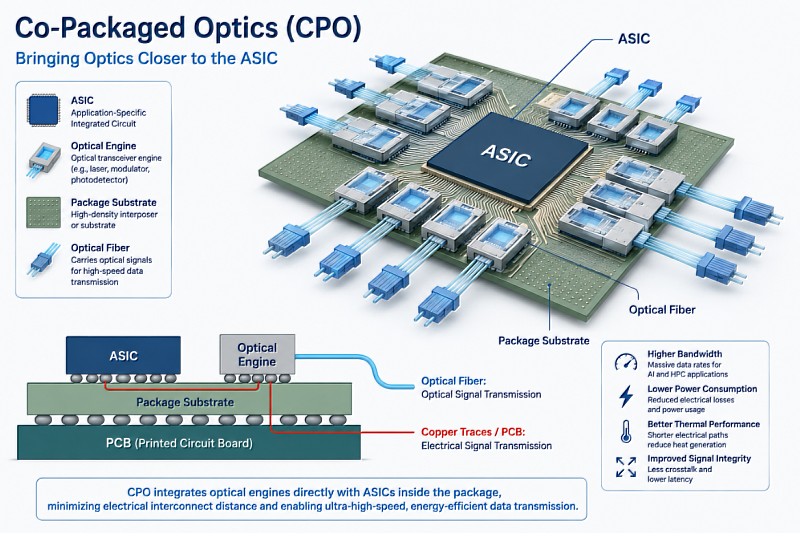
The technology could contribute to the development of co-packaged optics (CPO), an emerging architecture that places optical components much closer to AI processors and network switches. By shortening electrical transmission distances, CPO can significantly reduce power consumption and latency while overcoming one of the major performance bottlenecks in future AI computing systems.
As AI models continue to grow, demand for faster and more energy-efficient optical interconnects will only increase. By combining advanced silicon photonics with innovative optical transmission architectures, the collaboration between NYCU and HHRI demonstrates Taiwan’s growing leadership in silicon photonics and high-speed optical communications, while laying the groundwork for the next generation of AI data center infrastructure.
The research was led by Hao-Chung Kuo, director of the Semiconductor Research Institute at HHRI, and Chi-Wai Chow, distinguished professor at NYCU, together with researchers from both institutions. The project was supported by Taiwan’s National Science and Technology Council (NSTC) and the Industrial Technology Research Institute (ITRI), with additional research collaboration from the team led by Chair Professor Wood-Hi Cheng at National Chung Hsing University.