




- HHRI and NYCU Unveil Silicon Photonic Breakthrough for Next-Generation AI Data Centers
- NYCU, Military Academy Partner to Prepare the Next Generation of AI-Ready Military Leaders
- NYCU Student Rocket Team Completes Full Mission at World’s Largest Rocket Competition
- NYCU and Mackay Memorial Hospital Publish Study on Brainwave Monitoring During General Anesthesia
- NYCU Joins Taiwan Regenerative Medicine Alliance to Advance Next-Generation Healthcare
NYCU Joins Taiwan’s First High School–University–Research Alliance to Cultivate Future Scientists
(中央社訊息服務20260730 12:33:09)Around the world, countries are rethinking when future scientists should begin their research training. Rather than waiting until university, many are giving students opportunities to engage in authentic research during high school, recognizing that scientific talent is cultivated through years of curiosity, experimentation and mentorship.
To strengthen Taiwan’s research talent pipeline, National Yang Ming Chiao Tung University (NYCU) joined Academia Sinica, the Ministry of Education (MOE), National Taiwan University (NTU), National Tsing Hua University (NTHU) and National Cheng Kung University (NCKU) on July 29 to inaugurate the Preparatory Office of the National Taiwan Science Experimental High School and sign a memorandum of understanding (MOU).
The initiative establishes Taiwan’s first collaborative platform linking a research-focused high school with leading universities and Academia Sinica, creating a seamless pathway from secondary education to university and national research.
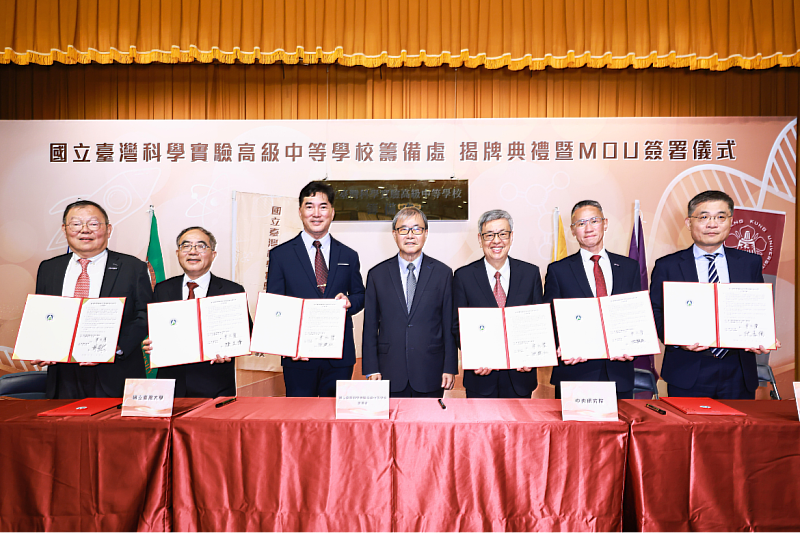
Through the partnership, students will gain early access to university laboratories, research mentorship, project-based learning and academic exchanges, allowing them to experience authentic scientific research well before entering university.
NYCU President Chi-Hung Lin said future researchers will need more than disciplinary expertise as artificial intelligence, semiconductors, biomedical science and other emerging technologies become increasingly interconnected. “With strengths spanning both medicine and engineering, NYCU has long championed interdisciplinary education and research,” Lin said. “By opening our research environment to students at an earlier stage, we hope to inspire scientific curiosity while creating a seamless pathway from high school to university and national research institutions.”
Drawing on its expertise in medicine, biomedical science, artificial intelligence, semiconductors, photonics and information technology, NYCU will provide students with opportunities to explore frontier research across multiple disciplines and develop the skills needed for future scientific careers.
Academia Sinica President James C.Y. Chen said cultivating scientific talent requires sustained collaboration between education and research institutions. “Scientific breakthroughs often result from years of persistence and the willingness to explore the unknown,” Chen said. “Introducing students to systematic research methods early helps foster scientific reasoning, critical thinking and independent inquiry.”
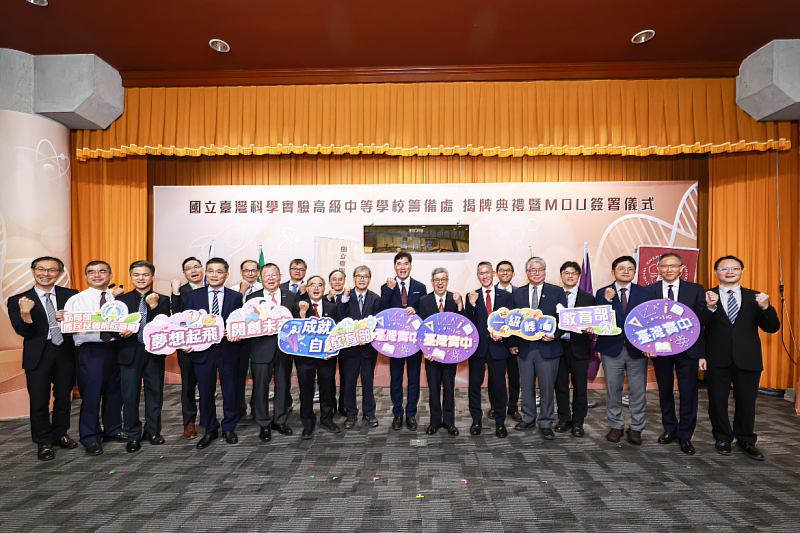
NYCU has long promoted interdisciplinary talent development through partnerships with high schools, science outreach, cross-disciplinary curricula and international collaborations.
The university will continue working with Academia Sinica, the Ministry of Education and partner institutions to integrate educational and research resources, expand opportunities for young researchers and strengthen Taiwan’s long-term scientific competitiveness by cultivating globally minded research talent.